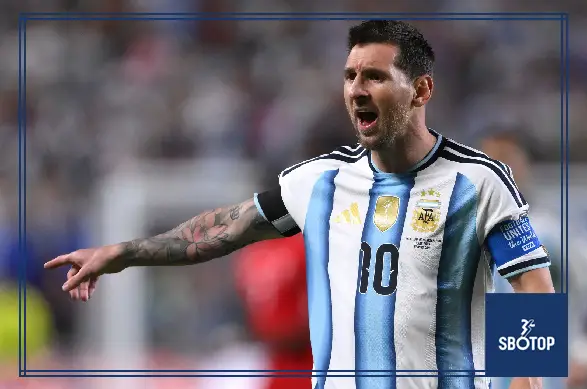
England’s path to the 2026 World Cup final now runs directly through Lionel Messi.
Thomas Tuchel’s side survived a bruising quarter-final against Norway, recovering from a goal down before Jude Bellingham scored twice to secure a tense 2-1 victory after extra time. Argentina endured an equally demanding evening, needing 120 minutes to overcome ten-man Switzerland 3-1.
Those results created one of the most eagerly anticipated matches of the tournament: England against Argentina in Atlanta, with a place in the World Cup final at stake.
The fixture carries decades of history, controversy and sporting tension. Yet it will also produce something entirely new. Despite representing Argentina for more than two decades, Messi has never previously faced England at senior international level. His first meeting with the Three Lions will come on the greatest possible stage, in what could be one of the final defining matches of his extraordinary career.
England have already been warned that preparing for Messi may be easier than controlling him.
Former England defender Micah Richards described marking the Argentine as effectively “impossible”, explaining that Messi’s selective movement makes him unusually difficult to track. He may appear detached from the action before drifting into a dangerous pocket, receiving the ball and transforming the match within seconds.
That is the challenge awaiting England: not merely stopping a famous player, but containing a footballer whose apparent inactivity is part of the threat.
A Historic Semi-Final in Atlanta
England and Argentina will meet at Atlanta Stadium on Wednesday, July 15, with kickoff scheduled for 3pm local time. The winner will advance to face either France or Spain in the final.
Both semi-finalists arrive after exhausting quarter-finals.
England were pushed deep into extra time by Norway in Miami. Andreas Schjelderup gave the Norwegians the lead before Bellingham equalised shortly before half-time. With the tie still level after 90 minutes, the Real Madrid midfielder struck again in extra time to send England through.
Tuchel was relieved by the result but dissatisfied with the performance. He praised his players’ resilience while warning that their technical level, ball circulation and overall control would have to improve significantly.
Argentina’s route was similarly uncomfortable. Alexis Mac Allister headed them ahead from a Messi corner against Switzerland, only for Dan Ndoye to equalise in the second half. Breel Embolo was then controversially sent off, but Argentina still struggled to break down ten opponents until Julián Álvarez scored from distance in the 112th minute. Lautaro Martínez added the final goal in stoppage time at the end of extra time.
Neither team reached the semi-finals with a flawless display. Both showed endurance, emotional strength and the ability to survive when their football became uncertain.
The difference is that Argentina possess Messi, a player capable of making an imperfect performance irrelevant.
Why Messi Remains So Difficult to Stop
Lionel Messi at 39 is not the same player who once accelerated past entire defensive units from the halfway line. His game now depends less on repeated explosive dribbles and more on intelligence, timing and efficiency.
That evolution has not reduced his influence. In some ways, it has made him even more difficult to read.
Messi often spends long passages walking, scanning the positions of defenders and studying the spaces around midfield. He does not constantly press, track runners or attempt to remain involved in every phase. Those periods can create the illusion that the opposition has successfully isolated him.
Then the match changes.
A defender moves several metres too far from the back line. A midfielder turns towards the ball rather than checking behind him. A passing lane opens for one moment. Messi recognises the opportunity before anyone else, receives possession and plays the decisive pass or finish.
Richards’ warning focused on this unpredictability. Traditional marking depends on relatively stable reference points: the defender knows where the forward wants to operate and can follow him into that zone.
Messi refuses to provide that certainty.
He drops into midfield, drifts towards the right, appears between the lines and occasionally moves away from the most obvious attacking space. If a centre-back follows him, Argentina can attack the vacant area. If a midfielder hesitates, Messi can receive and turn. If England attempt to pass responsibility between several players, one moment of confusion may be enough.
His tournament numbers demonstrate that the threat remains enormous. FIFA listed Messi with eight goals and one assist from his first five appearances, giving him nine direct goal contributions before the semi-final.
England cannot approach him as a ceremonial figure nearing retirement. They must treat him as one of the tournament’s most productive attackers.
Tuchel Must Avoid the Man-Marking Trap
The most obvious solution would be to assign one player to follow Messi everywhere.
It would also be extremely dangerous.
A dedicated marker could be pulled away from England’s structure, opening spaces for Álvarez, Mac Allister, Enzo Fernández or Rodrigo De Paul. Argentina’s system is built to benefit from the attention Messi attracts. Every defender who moves towards him creates an opportunity somewhere else.
England therefore need a collective plan rather than a personal duel.
Their defensive midfielders must protect the central zones without becoming obsessed with Messi’s every movement. The centre-backs must know when to step forward and when to hold the line. The full-backs must remain alert to Argentina’s overlapping runs, particularly when Messi drifts infield.
Communication will be essential.
When Messi changes zones, England must pass responsibility smoothly from one defender to another. A midfielder may initially close him down, but a centre-back must be ready if he moves closer to the penalty area. Meanwhile, another player must cover the space left by the defender who engages him.
The objective cannot realistically be to prevent Messi from touching the ball. England should instead attempt to control where he receives it and what options are available afterwards.
Possession near the halfway line is less dangerous than possession 20 metres from goal. Receiving with his back to the attack is preferable to turning into open space. Forcing him towards crowded areas may reduce his ability to create, even when England cannot remove him from the match completely.
England Must Defend the Pass Before It Reaches Messi
One of the most effective ways to limit a great playmaker is to disrupt the supply around him.
England can attempt to pressure Argentina’s deeper midfielders, preventing them from finding Messi cleanly between the lines. De Paul, Fernández, Mac Allister and Leandro Paredes all provide different routes into the attacking phase. Allowing them time to raise their heads and select passes would place England’s defence under constant stress.
Tuchel may therefore ask his forwards to press more aggressively than they did against Norway.
Harry Kane will have to screen passes into midfield while choosing the right moments to engage Argentina’s centre-backs. The wide attackers must close the angles towards the full-backs, and Bellingham may be required to apply pressure from a more advanced position.
However, England must press intelligently.
An undisciplined charge towards the ball could leave Messi standing free behind the first line. Argentina would then need only one accurate pass to eliminate several England players.
The ideal approach is controlled aggression: enough pressure to make Argentina uncomfortable, but enough discipline to preserve the spaces Messi wants to occupy.
Argentina Are More Than One Player
The fascination surrounding Messi can easily distort the tactical picture.
Argentina do not reach repeated major-tournament semi-finals through the talent of one individual alone. Their success under Lionel Scaloni has been built upon an organised, competitive and emotionally committed group that understands how to support its captain.
Scaloni has shaped the team around Messi’s strengths without removing responsibility from everyone else.
De Paul supplies relentless running and covers large areas when Messi remains high. Mac Allister brings technical control and intelligent movement. Fernández can accelerate possession with progressive passing. Álvarez presses defenders, attacks space and creates room through constant movement.
At the back, Cristian Romero and Lisandro Martínez provide aggression, while goalkeeper Emiliano Martínez carries enormous confidence in knockout situations.
Switzerland exposed weaknesses, but Argentina still found three different scorers and remained composed enough to settle the contest late in extra time.
England must therefore resist turning the semi-final into eleven players against Messi.
Overcommitting to the captain would allow Argentina’s other match-winners to operate with less pressure. The better strategy is to restrict the entire network that allows Messi to influence the game.
England Have Reasons to Believe
The mission may have been labelled impossible, but Argentina are not untouchable.
Their knockout campaign has repeatedly placed them under pressure. They required extra time to defeat Cape Verde, produced a dramatic late comeback against Egypt and were taken beyond 90 minutes again by Switzerland. Argentina’s ability to survive those matches demonstrates formidable character, but it also suggests that opponents can disturb their rhythm.
Switzerland troubled them through physical intensity, compact defending and direct transitions. Even after being reduced to ten men, the Swiss remained competitive until the closing stages of extra time.
England possess the athleticism to apply similar pressure with greater attacking quality.
Bellingham can break through midfield, Kane can link play and finish chances, while England’s wide players can attack an Argentine defence that does not always look comfortable when forced to retreat quickly.
Tuchel’s squad also has depth. He can introduce pace from the bench, alter the shape or add another midfielder if England lose control.
The concern is that England’s quarter-final performance lacked fluency. Their passing against Norway was often slow, and Kane received limited service in dangerous positions. Bellingham’s individual intervention rescued them, but relying on another rescue against Argentina would be risky.
Tuchel has already made the standard clear: England must play better.
Bellingham Versus Argentina’s Midfield
Bellingham enters the semi-final as England’s most influential tournament player.
His two goals against Norway carried England into the last four and increased his tournament total to six. Kane also had six after the quarter-final, while Messi remained ahead with eight.
Argentina will understand that controlling Bellingham is almost as important as England’s plan for Messi.
The midfielder’s greatest strength is his ability to appear wherever the match needs him. He can collect possession deep, drive through pressure, support Kane and arrive inside the penalty area. His movements are difficult to assign to one defender because he does not remain within a fixed role.
That creates a fascinating contrast.
Messi controls games through calculated movement and exceptional economy. Bellingham influences them through energy, timing and force. One appears to wait for the match to reveal itself; the other attempts to take control of it.
If Argentina’s midfield becomes too focused on England’s passing structure, Bellingham can break beyond them. If they remain deep to protect their penalty area, he may have room to carry the ball forward.
England need him to produce more than goals. They need him to compete with Argentina’s midfield, resist emotional provocation and maintain the tempo Tuchel demanded after the Norway match.
Kane Must Occupy Argentina’s Centre-Backs
Kane will also have a crucial role, even when he is not scoring.
Argentina’s defenders are aggressive and comfortable stepping into challenges. Kane can exploit that tendency by dropping away from the penalty area and inviting a centre-back to follow him.
That movement could create space for Bellingham and England’s wide attackers to run behind.
However, England must avoid leaving their captain too far from goal. Against Norway, Kane frequently moved deeper in search of involvement, reducing England’s presence inside the box.
The semi-final requires balance.
Kane should help England progress through midfield, but he must also occupy the defenders and provide a finishing target. Argentina will be satisfied if England’s most reliable goalscorer spends the match receiving possession near the centre circle.
His pressing will matter too. Argentina prefer to build patiently, and Kane’s positioning can direct their passes towards areas where England are prepared to apply pressure.
Also Read: