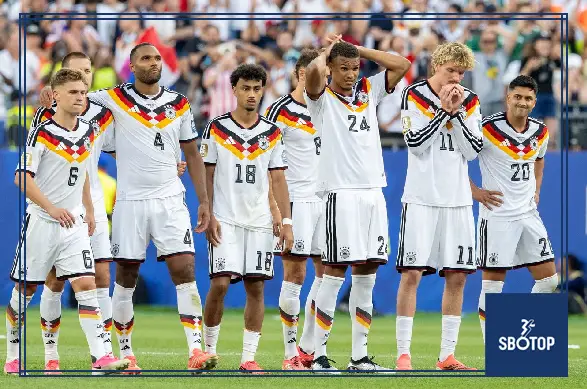
There was a time when Germany’s presence in the World Cup knockout rounds felt less like participation and more like a warning. The shirt, the history, the discipline, the cold efficiency from the penalty spot — all of it created an aura that intimidated opponents before the match even began. Germany did not always play beautifully, but they usually found a way. They survived chaos, punished mistakes, and turned tournament pressure into something close to a national advantage.
That aura has faded.
Germany’s latest World Cup collapse, a round-of-32 penalty shootout defeat to Paraguay, was shocking in name but not completely shocking in performance. The four-time champions were eliminated after a 1-1 draw over 120 minutes and a 4-3 defeat on penalties, with Jose Canale scoring the decisive kick for Paraguay. Reuters described it as one of the biggest upsets in World Cup history, but the deeper truth is harsher: Germany no longer look like a team protected by their past.
This was not simply one bad night. It was the latest chapter in a pattern. Germany failed badly at the 2018 World Cup, disappointed again in 2022, and have now fallen short once more in 2026. Reuters reported that the Paraguay exit marked a third straight World Cup failure for a country that once defined consistency at the highest level.
The question is no longer whether Germany can have an off night. The question is whether Germany are still elite at all.
Paraguay Did Not Beat the Old Germany
Paraguay’s victory was courageous, disciplined, and fully deserved. They did not dominate possession, nor did they need to. They stayed compact, absorbed pressure, created their moment through Julio Enciso, and then held their nerve when the match entered the most unforgiving phase of knockout football.
Germany equalized through Kai Havertz, but the response did not feel like the start of an inevitable comeback. Instead, it felt like a temporary correction in a match that remained uncomfortable. Paraguay continued to believe. Germany continued to search.
Sky Sports reported that Enciso put Paraguay ahead in the 42nd minute before Havertz made it 1-1 early in the second half. Germany later thought Jonathan Tah had won the match in extra time, only for VAR to rule out his header before the contest went to penalties.
That sequence tells the story of modern Germany. They had moments. They had pressure. They had enough talent to create danger. But they did not have the certainty, authority, or killer instinct that once defined them.
The old Germany would have turned pressure into inevitability. This Germany turned pressure into anxiety.
The Penalty Myth Finally Broke
For decades, Germany and penalties were almost inseparable from football mythology. Other nations carried trauma from the spot. Germany carried confidence. The walk from halfway seemed made for them. They were calm, ruthless, and historically terrifying.
Paraguay shattered that myth.
Havertz, Nick Woltemade, and Jonathan Tah all failed to convert in the shootout, while Paraguay held firm long enough for Canale to finish the job. Reuters reported that this was Germany’s first World Cup penalty shootout defeat, a symbolic rupture for a team long associated with mental strength from the spot.
That detail matters because penalty shootouts are not just technical contests. They are identity tests. When Germany lose a shootout, it hits differently. It does not merely eliminate them from a tournament; it attacks one of the last surviving pillars of their old reputation.
The Guardian noted that Germany once scored 22 consecutive penalties in major tournament shootouts, but against Paraguay they missed three. That contrast captures the whole decline in one brutal image. Germany used to make the hardest moments look manageable. Now even their strongest historical weapon looks fragile.
The Problem Is Bigger Than Nagelsmann
Julian Nagelsmann will naturally carry responsibility. He was the coach. He selected the team, shaped the system, managed the match, and prepared the squad for knockout football. When Germany crash out early, the manager cannot escape scrutiny.
But blaming only Nagelsmann would be too easy.
Reuters reported that Nagelsmann was set to step down after the elimination, according to Bild, following talks with German football officials. The report also noted that he had taken over in 2023 and became the youngest coach to lead a side in a World Cup knockout match in four decades.
Yet Germany’s problems have survived multiple coaches. Joachim Low oversaw the 2018 failure. Hansi Flick could not fix the slide in 2022. Nagelsmann could not restore authority in 2026. Three different eras, three different versions of disappointment.
That is why the issue feels structural rather than personal. Germany can replace the coach, but a new coach alone will not restore the aura. The deeper problem is that Germany no longer consistently produce a national team that looks greater than the sum of its parts.
The machine is not just misfiring. The machine may need rebuilding.
Kahn’s Warning Cuts to the Core
Oliver Kahn, one of the defining symbols of German tournament mentality, has pointed toward a deeper issue: responsibility. His analysis focused less on tactics and more on the willingness of players to take ownership in decisive moments. Bavarian Football Works reported Kahn’s view that Germany lack confidence to take responsibility when pressure reaches its highest point, especially after the hesitation around penalty takers in the Paraguay shootout.
That criticism matters because Kahn knows what old Germany represented. He lived it. He embodied it. He understands that tournament football is not just about formation diagrams or passing networks. It is about who demands the ball when failure is most visible.
Germany’s shootout confusion became a metaphor for the entire decline. A great team does not look around for someone to volunteer in a World Cup knockout shootout. A great team has players who want that moment.
This is not to say the current squad lacks character entirely. Some players did step up. Some carried the burden. But the collective picture was troubling. Germany did not radiate authority. They looked like a side hoping someone else would solve the problem.
For a country built on responsibility, that is a painful change.
Kroos Says What Many Are Thinking
Toni Kroos offered an even harsher diagnosis. Bavarian Football Works reported that the former Germany midfielder argued the current national team does not have a single truly world-class player, while stressing that potential is not the same as proven elite quality.
It is a severe statement, but it explains why Germany’s decline feels different now. In the past, even when the team looked imperfect, there were players who could bend a match toward Germany’s will. There were leaders in every line, technicians who controlled tempo, defenders who dominated duels, and forwards who punished hesitation.
The current squad has talent. Florian Wirtz has imagination. Jamal Musiala, when available and fit, is a rare creator. Havertz has intelligence and versatility. Joshua Kimmich remains a high-level competitor. But as a collective, Germany do not yet possess the frightening certainty of earlier generations.
The team often looks promising rather than complete. Interesting rather than intimidating. Capable rather than inevitable.
That is the harsh reality: opponents respect Germany, but they no longer fear them in the same way.
The Numbers Do Not Flatter Them
Beyond emotion and reputation, the numbers from Germany’s tournament are worrying. Bavarian Football Works highlighted that Germany attempted 55 crosses against Paraguay, including corners, but completed only 10. The same analysis noted that Germany won only 47 percent of their duels during the tournament, their lowest duel-success figure in World Cup history.
Those statistics are revealing. The crossing number suggests attacking desperation rather than attacking clarity. Germany were sending balls into the box because they had run out of better ideas. The duel number suggests they were not imposing themselves physically either.
That is a damaging combination. If a team is not precise enough to play through an opponent and not dominant enough to overpower them, it becomes vulnerable to exactly the kind of match Paraguay created: long, tense, narrow, and emotionally exhausting.
Germany once controlled knockout games through details. Now details expose them.
The same Bavarian Football Works analysis noted that Germany have managed only one quarter-final appearance since 2016, after reaching at least the semi-finals in six consecutive major tournaments from 2006 to 2016. That is not a temporary dip. That is a lost decade beginning to take shape.
The 2014 Shadow Has Become Heavy
The 2014 World Cup triumph in Brazil remains a glorious reference point, but it also casts a long shadow. That team had balance, leadership, tactical intelligence, and a sense of collective maturity. They were not only talented; they understood themselves.
The current Germany do not seem to have that same clarity. They often appear caught between styles, between generations, and between expectations. They want to dominate possession, but do not always move the ball quickly enough. They want attacking fluidity, but often lack penalty-box ruthlessness. They want to press, but do not always sustain physical control.
That uncertainty has created a dangerous gap between memory and reality. Germany still carry the branding of a superpower, but their recent tournament results tell a very different story.
The badge says giant. The performances say rebuilding project.
That contradiction is one reason their exits feel so jarring. People still expect Germany to behave like Germany. But perhaps the harder truth is that this version is not failing to live up to its potential. Perhaps this version is showing exactly where Germany currently are.
The World Has Caught Up
Germany’s decline is not happening in isolation. The rest of international football has changed. Teams once viewed as outsiders are now tactically organized, physically powerful, and psychologically prepared. Paraguay did not arrive as a naive underdog waiting to be overwhelmed. They arrived with a plan.
The same tournament has shown other traditional hierarchies being tested. Morocco eliminated the Netherlands on penalties. Switzerland reached the next round. Paraguay now face France with the confidence of a team that has already beaten one giant.
The global game has flattened. Modern coaching, data, conditioning, and player development have narrowed the gap. A famous shirt is no longer enough.
This is especially dangerous for Germany because their historical advantage was partly cultural. They were more organized, more ruthless, more prepared. Now many teams are organized. Many teams are ruthless. Many teams are prepared.
If Germany are no longer technically superior, physically dominant, or mentally stronger, then history alone cannot protect them.
Also Read: