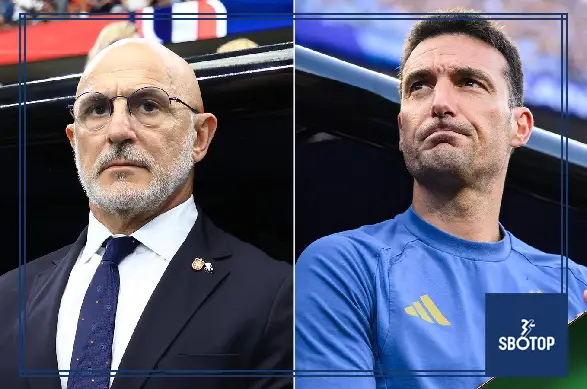
The 2026 World Cup final between Spain and Argentina is more than a meeting of two elite national teams. It is also a verdict on the qualities that matter most in international management. Luis de la Fuente and Lionel Scaloni have guided their countries to the biggest match in football, while Thomas Tuchel’s England and Carlo Ancelotti’s Brazil have been left to study campaigns that promised more than they ultimately delivered.
Yet Spain and Argentina reached the final because their coaches understood a fundamental truth: international management is not simply club management with fewer matches. It is a different profession. The best national-team coach must simplify without becoming predictable, create unity without suppressing individuality, and make decisive changes without flooding players with information. De la Fuente and Scaloni have done those things better than their more celebrated rivals.
De la Fuente Built Spain Before He Managed Spain
De la Fuente’s greatest strength is not a clever formation or a dramatic touchline intervention. It is his deep understanding of Spanish footballers and the pathway that produces them. Before becoming senior national-team coach, he worked with Spain’s youth sides and helped develop many players who later became important at the highest level. His authority therefore comes from relationships, continuity and an intimate knowledge of the national football culture.
Spain still value possession, technical superiority and positional intelligence, but they are no longer trapped by the idea that control must mean endless passing. Under De la Fuente, they can attack quickly, use the width provided by dynamic wingers, press aggressively and defend with discipline.
Their 2-0 semifinal victory over France was a perfect illustration. France possessed extraordinary attacking talent, including Kylian Mbappé, Ousmane Dembélé and Michael Olise, but Spain controlled the contest and prevented those stars from determining it. De la Fuente’s team did not merely survive France; they imposed themselves on one of the strongest squads in the tournament and advanced with authority.
Spain’s defensive record has been equally important. Ahead of the final, they had conceded only one goal during the tournament and were unbeaten across a 37-match run excluding penalty shootouts. Those numbers reflect much more than individual quality. They show a team with reliable distances between the lines, coordinated pressing and a shared understanding of how to respond when possession is lost.
De la Fuente has also mastered one of the hardest parts of international management: giving freedom to exceptional players without weakening the collective. Lamine Yamal can take risks because the structure behind him is secure. Midfielders can rotate because teammates understand how to fill the spaces they leave. Full-backs can advance because the rest of the team recognises the defensive consequences.
This is not tactical freedom in the careless sense. It is organised freedom. Players know their responsibilities well enough to express themselves.
Scaloni’s Argentina Thrive on Adaptability
If De la Fuente represents continuity and structural clarity, Scaloni represents adaptability. Argentina can play with control, directness, aggression or patience depending on the opponent and the moment. They are capable of building through midfield, attacking transitions, defending deeper or increasing pressure late in a match.
That flexibility was decisive against England in the semifinal. Argentina fell behind but did not lose their emotional or tactical balance. While England became increasingly cautious, Scaloni’s side kept searching for ways to move the game closer to the English penalty area. The pressure eventually produced a 2-1 comeback and another place in a World Cup final.
Scaloni’s management is often described through emotion because Argentina play with visible intensity and unity. But emotion alone does not explain their success. His most impressive achievement is the way he has connected competitive spirit to tactical discipline. Argentina can be fierce without becoming chaotic. They can play for Lionel Messi without making every attack dependent on him. They can change shape without appearing confused.
The team’s late-game strength is another sign of good coaching. Knockout football frequently becomes less organised as fatigue and pressure increase. Argentina often appear more dangerous in those moments because their players understand which risks are acceptable. The substitutes enter with clear roles. The senior players recognise when to slow the game and when to accelerate it.
Scaloni also understands that international tournaments are emotional journeys. A squad may spend more than a month together under enormous public pressure, with every selection decision capable of becoming a national debate. The coach must keep non-starting players involved, protect the group from external noise and ensure that disappointment does not become division.
Argentina’s repeated ability to win tense matches suggests that Scaloni has created precisely that kind of environment. His players do not behave like a collection of stars waiting for Messi to rescue them. They behave like a team convinced that every member has a role in protecting the country’s status as world champion.
Tuchel’s Detail Became Hesitation
Tuchel’s England reached the semifinals, so their campaign cannot reasonably be described as a complete failure. England also defeated France 6-4 in the third-place playoff, securing their best World Cup finish since winning the tournament in 1966. Nevertheless, the semifinal defeat exposed a weakness that has followed several talented England teams: the instinct to protect a narrow advantage instead of building on it.
England led Argentina 1-0, but their approach became progressively more defensive. Tuchel introduced additional defensive players and removed outlets who might have forced Argentina to remain cautious. The intention may have been to control space, but the practical effect was to invite pressure.
Tuchel later said he had no regrets about his decisions. That position is understandable from a coach who believed the changes were tactically logical. International tournaments, however, are judged not only by the theory behind decisions but by the messages those decisions send to players.
When a team leading a semifinal replaces attacking energy with defensive security, the players can interpret the change as an instruction to survive. The defensive line drops a few metres. Midfielders become reluctant to break forward. Clearances replace passes. The opponent senses anxiety and attacks with greater confidence.
That is exactly where Scaloni outperformed Tuchel. Argentina’s changes increased their capacity to influence the match, while England’s reduced their ability to threaten. One coach used substitutions to expand his team’s possibilities; the other used them to narrow the game.
Tuchel’s club background may also have encouraged an excessive faith in tactical correction. At club level, a manager has months to rehearse multiple structures. At international level, complicated adjustments can create hesitation because players have limited training time together. The smartest solution is often the clearest one.
England did not need to abandon structure and attack recklessly. They needed to preserve enough forward threat to stop Argentina from controlling territory without consequence. By sacrificing that threat, Tuchel solved one problem on paper while creating a larger one on the field.
Ancelotti Could Not Resolve Brazil’s Identity Crisis
Brazil’s elimination by Norway in the round of 16 was one of the tournament’s biggest shocks. The 2-1 defeat extended the country’s wait for a sixth world title and raised difficult questions about the direction of the national team.
Ancelotti seemed an ideal appointment because of his experience with Brazilian stars and his reputation for calm, flexible management. But international football offers little time for reputation to become identity. Brazil entered the tournament caught between generations and between competing ideas of how the team should play.
Reuters’ analysis of the defeat argued that Brazil attempted to balance the old guard with the future and ended up falling between them. That diagnosis reaches the heart of Ancelotti’s problem. His squad contained talent, but talent alone does not answer the essential questions: Who controls the rhythm? Where does the pressing begin? How are the attacking players connected? What happens when the first plan fails?
Ancelotti is famous for adapting systems to suit his best players. That quality has brought extraordinary club success, but national-team adaptation requires a clear foundation. Brazil did not appear to possess one strong enough to survive the pressure of knockout football.
Norway exposed a team that could produce moments without consistently controlling matches. Once Brazil were placed under stress, their football became less coherent. The attack searched for individual solutions, while the collective mechanisms needed to regain control were insufficient.
The defeat also highlighted the importance of timing in international appointments. A coach requires enough matches to identify his core group, establish relationships and test alternatives under pressure. Even a manager of Ancelotti’s experience cannot instantly manufacture the shared instincts that De la Fuente developed over years or Scaloni built across multiple tournaments.
Also Read: