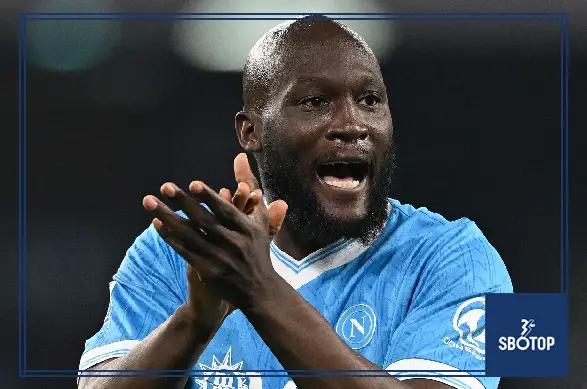
Romelu Lukaku’s future at Napoli has become increasingly uncertain after his agent warned that the Belgian striker will not remain at the club merely to serve as a backup option.
Federico Pastorello has made it clear that Lukaku still considers himself capable of playing a leading role at the highest level. With the forward entering the final year of his Napoli contract, the comments have placed pressure on the Italian club to clarify its plans before the new season begins.
The issue centres on Napoli’s attacking hierarchy and the growing importance of Rasmus Højlund. Lukaku endured an extremely difficult 2025–26 campaign after suffering a serious muscle injury during preseason. He barely featured throughout the season, while Napoli developed alternative attacking solutions in his absence.
Pastorello insists that the lost campaign has not changed his assessment of Lukaku’s quality. The agent believes his client remains one of the leading centre-forwards in European football and should not be expected to accept a secondary role simply because injury disrupted his previous season.
His message was direct: Lukaku is not the type of player who will stay somewhere he does not feel wanted.
That statement does not necessarily mean a transfer has already been arranged. It does, however, create a clear challenge for Napoli. The club must either demonstrate that Lukaku remains an important part of its sporting project or consider allowing him to leave before his contract expires in 2027.
An Agent’s Warning With Strategic Purpose
Public comments from agents are rarely accidental. Pastorello’s intervention appears designed to force clarity at a moment when Napoli are making important squad decisions. Rather than allowing Lukaku to enter preseason without knowing his status, the agent has placed the issue into the public conversation.
The wording matters.
Pastorello did not simply say that Lukaku wants more minutes. He argued that the striker cannot remain as Højlund’s backup and suggested that his client would not stay at a club where he was no longer genuinely valued.
That language establishes a strong negotiating position.
Napoli now understand that Lukaku is unlikely to quietly accept a place on the bench for the final year of his contract. Interested clubs also know that the player may be available if Napoli cannot offer him a meaningful role.
For the striker, the objective may be less about creating conflict and more about avoiding another wasted season.
At 33, Lukaku cannot afford to spend an entire campaign waiting for occasional substitute appearances. Younger players can accept a developmental role because time remains on their side. An experienced forward approaching the final phase of his career must think differently.
Every season now carries greater significance.
Lukaku will want regular football, an important tactical role and the chance to prove that his difficult campaign was caused by injury rather than permanent decline.
A Remarkable First Season in Naples
The current uncertainty contrasts sharply with Lukaku’s first year at Napoli. He joined the club in 2024 and quickly became central to Antonio Conte’s attacking system. The relationship between the two men had already produced success at Inter Milan, where Lukaku played some of the best football of his career.
At Napoli, the striker again became a focal point.
He scored 14 league goals and supplied 10 assists as Napoli won the Serie A title during the 2024–25 season. Those numbers demonstrated that his contribution extended beyond finishing. Lukaku held up possession, brought midfielders into attacks and created opportunities for teammates.
His physical presence gave Napoli a reliable route forward.
When opponents pressed aggressively, defenders could play directly toward Lukaku. He could protect the ball, wait for support and help the team move into more advanced positions.
When Napoli controlled possession, he occupied centre-backs and opened space for runners around him.
The title-winning campaign appeared to confirm that the move had worked for everyone. Napoli gained an experienced striker suited to Conte’s demands, while Lukaku rediscovered stability after several unsettled years involving Chelsea, Inter and Roma.
Few would have expected his position to become so uncertain only one season later.
Injury Changes the Entire Picture
Lukaku’s second campaign was damaged before it had properly begun.
A severe preseason muscle injury ruled him out for the first half of the season and prevented him from building on the momentum of Napoli’s title success.
When he eventually returned, he struggled to regain full fitness and rhythm. Reports indicate that he managed only a handful of substitute appearances in Serie A and scored once during an extremely limited campaign. Across all club competitions, his total playing time was reported to be just 64 minutes.
Those circumstances are important when evaluating his future.
A season with almost no football does not offer enough evidence to determine whether Lukaku can still perform regularly at a high level. His lack of minutes was primarily connected to physical problems rather than repeated poor performances.
However, football clubs cannot base plans entirely on past achievements.
Napoli had to continue without him. Other forwards gained opportunities, tactical relationships developed and the club’s attacking structure changed.
By the time Lukaku was ready to return, he was no longer automatically at the centre of the project.
This is the tension behind Pastorello’s comments.
The agent wants Napoli to judge Lukaku by his proven quality and title-winning contribution. The club must also consider his age, recent injury record and the progress of its other forwards.
Højlund’s Rise Creates a Selection Dilemma
The presence of Højlund has become central to the debate.
The Danish striker offers youth, mobility and long-term potential. If Napoli now see him as the primary centre-forward, Lukaku would face a very different role from the one he accepted when joining the club.
Competition between strikers is normal at an elite team. Napoli need more than one option across Serie A, domestic cup matches and European competition.
The problem is not competition itself. The problem is hierarchy.
Lukaku may be willing to compete for his place, but his agent’s comments suggest that he will not accept entering the season with his status already fixed as second choice.
There is an important distinction between rotation and permanent backup duty.
A rotating striker may start regularly, feature in major matches and remain central to the manager’s tactical thinking. A backup is generally used only when the preferred player is injured, suspended or resting.
Pastorello’s message indicates that the second arrangement would be unacceptable.
Napoli must therefore decide whether they can genuinely provide enough responsibility to satisfy both forwards.
Can Two Leading Strikers Coexist
From a purely sporting perspective, Napoli could benefit from keeping both Lukaku and Højlund.
The modern calendar is demanding, and injury can quickly expose a squad that lacks depth. Napoli experienced that reality when Lukaku was unavailable for most of the previous season.
The two players also possess different characteristics.
Lukaku provides physical strength, experience and the ability to play with his back to goal. He can occupy defenders, protect direct passes and create space for attacking midfielders.
Højlund offers greater mobility over distance and may be better suited to pressing aggressively or attacking open space behind a high defensive line.
A coach could select between them depending on the opponent. In certain situations, they might even play together.
However, tactical possibility does not always solve the problem of personal expectations.
Both players will want to start important matches. Both will believe that regular football is essential. If the manager clearly prefers one, the other may become dissatisfied.
Squad depth is valuable only when the players involved accept their roles.
Napoli cannot simply retain Lukaku because having an experienced striker on the bench appears useful. The club must consider whether that arrangement would remain productive across an entire season.
Lukaku’s Career Has Rarely Been Quiet
Uncertainty has followed Lukaku through much of his senior career.
He emerged at Anderlecht as one of Europe’s most exciting teenage strikers before moving to Chelsea. His first spell in England included productive loans at West Bromwich Albion and Everton, followed by a permanent move to Goodison Park.
Lukaku later joined Manchester United, where he scored regularly but never became completely secure in the club’s long-term plans.
His transfer to Inter transformed his career.
Under Conte, he became the central figure in a powerful, direct attacking system and helped Inter win the Serie A title. He then returned to Chelsea in a major transfer, but the reunion quickly became difficult.
A controversial interview, tactical problems and inconsistent performances damaged his relationship with the London club. Loans to Inter and Roma followed before Napoli finally offered a permanent escape.
His career has therefore contained repeated transitions between clubs, countries and tactical systems.
Despite that instability, his scoring record remains exceptional. He has produced goals in Belgium, England and Italy while becoming his country’s record international scorer.
That history explains why Pastorello rejects the idea of Lukaku simply accepting a minor role.
The Conte Relationship Has Been Tested
Lukaku’s relationship with Conte has often been presented as one of the strongest player-coach partnerships in modern European football.
Conte trusted him at Inter and later pushed for his arrival at Napoli. Lukaku, in turn, appeared to understand the manager’s tactical demands and responded to his intense methods.
The relationship became more complicated during the injury-hit campaign.
In March 2026, Napoli publicly stated that Lukaku had failed to respond to an instruction to return to club training after withdrawing from Belgium duty. The striker remained in Belgium for treatment, explaining that he was dealing with inflammation and fluid around his hip flexor near existing scar tissue.
Napoli warned that disciplinary action could follow.
Lukaku insisted that he had not turned his back on the club and said he wanted to return only when he was fully fit. The disagreement nevertheless revealed tension between the player’s preferred rehabilitation approach and Napoli’s expectations.
That episode may influence the current situation.
Even when both sides publicly emphasise commitment, trust can be weakened by disagreements over fitness, communication and authority.
Pastorello’s warning may therefore concern more than playing time. It may also reflect a need to repair the relationship between Lukaku and the club.
Napoli Must Protect Their Own Interests
Napoli cannot allow emotion to determine their decision.
Lukaku was important to the title victory, but the club must plan for the future. He is entering the final year of his contract, and his age means his value is unlikely to increase.
If Napoli do not expect him to play regularly, selling him during the current window may be the most logical financial option.
Allowing him to remain as an unhappy substitute could create several problems.
The club would continue paying a significant salary, his market value could decline further and he might leave without a transfer fee when his contract expires.
There is also a dressing-room consideration.
Lukaku is an experienced and influential figure. If he feels excluded, speculation around his position could become a constant distraction.
That does not mean he would behave unprofessionally. Pastorello has emphasised that Lukaku is not someone who wants to stay where he is unwanted, suggesting that he would prefer a clear solution rather than prolonged conflict.
Napoli must decide early enough to avoid uncertainty affecting preseason.
Also Read: