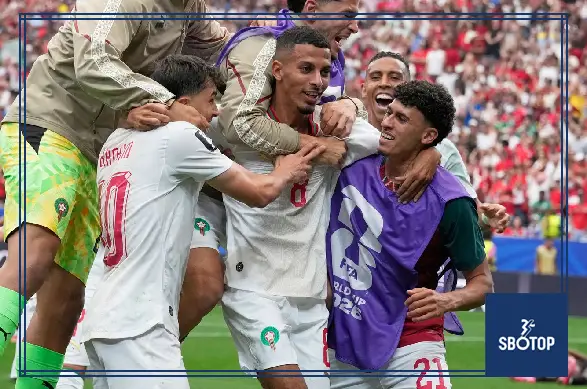
Morocco are back in the World Cup quarter-finals, and this time it feels less like a miracle and more like confirmation. Four years after stunning the football world by reaching the semi-finals in Qatar, the Atlas Lions have returned to the last eight with a ruthless 3-0 victory over co-hosts Canada. It was a night built on patience, precision, and the clinical edge that separates good tournament teams from dangerous ones.
Azzedine Ounahi was the star, scoring twice after half-time before substitute Soufiane Rahimi added a stoppage-time third. Morocco had been second-best for long stretches of the first half, but they absorbed pressure, waited for Canada’s intensity to fade, and then punished the co-hosts with cold efficiency. Reuters reported that Morocco scored three times from only four shots on target, underlining just how ruthless they were when the decisive moments arrived.
For Canada, the defeat ends a proud and emotional World Cup journey. Jesse Marsch’s side fought hard, started brightly, and carried the hopes of a co-host nation, but they lacked the finishing quality to turn pressure into goals. Morocco, by contrast, looked like a team that knows how to suffer, adjust, and strike.
That is why they are still alive.
Canada Start With Energy and Belief
Canada did not begin like a team ready to be eliminated. Backed by home energy and the desire to extend their historic run, they pressed aggressively, pushed Morocco backward, and created the better early chances. The Canadians wanted to make the match physical, fast, and uncomfortable. For a while, they succeeded.
Morocco struggled to escape their own half during the opening stages. Reuters noted that Canada dominated the first half and that Morocco did not register a shot until the 28th minute. That statistic tells the story of the early rhythm. Canada were first to loose balls, sharper in the duels, and more willing to attack directly.
Tani Oluwaseyi and Jonathan David both had opportunities to give Canada the lead, but the breakthrough never came. That became the defining frustration of their night. At this level, early pressure is only valuable if it becomes a goal. Canada gave Morocco problems, but they did not damage them on the scoreboard.
Against a team as experienced and streetwise as Morocco, that failure proved costly.
Morocco Bend but Do Not Break
The most impressive part of Morocco’s performance was not the scoreline. It was their ability to remain calm when the game was not going their way. Many teams panic when they are pressed high, especially in a knockout match against a host nation. Morocco did not.
They defended compactly, kept their shape, and accepted that the first half might require patience rather than dominance. The Guardian described the match as one defined by Morocco’s defensive resilience and counter-attacking intelligence, with the Atlas Lions reverting to a more pragmatic approach despite their recent shift toward a more progressive style under Mohamed Ouahbi.
That adaptability matters. Morocco are no longer only the surprise package of 2022. They are a mature team with different ways to win. They can press when needed, sit deep when required, and attack with devastating timing. Against Canada, they chose survival first and punishment second.
It was not always pretty, but tournament football rarely rewards beauty alone. It rewards balance, control, and execution. Morocco had all three when it mattered.
Ounahi Changes the Match
The match changed after half-time, and Ounahi was the reason. His first goal broke Canada’s resistance and shifted the emotional weight of the night. Morocco worked a clever free-kick routine, and Ounahi finished with the confidence of a midfielder who has grown into one of his country’s most important tournament players.
Reuters reported that Ounahi became the first African player to score a brace in a World Cup knockout match since 2002, a statistic that places his performance in continental football history. His second goal later in the match killed Canada’s remaining belief and confirmed Morocco’s control.
Ounahi has been central to Morocco’s modern rise. In 2022, he was one of the breakout midfielders of the tournament, combining elegance with relentless running. In 2026, he looks more mature, more decisive, and more comfortable carrying responsibility. Against Canada, he did not simply play well. He delivered the moments that changed the match.
That is what elite midfielders do in knockout football.
Canada Pay for Missing Davies
Canada were without Alphonso Davies, and his absence was impossible to ignore. Davies is not only their most famous player; he is their most explosive outlet, their best carrier from deep, and a player capable of changing a match with one run. Without him, Canada still had energy and structure, but they lacked the individual spark that might have turned early pressure into a goal.
Reuters highlighted Davies’ absence as part of Canada’s difficulty, noting that the co-hosts failed to convert early chances before fading after Morocco’s opener. That is the brutal truth. Canada competed well, but they did not have enough sharpness in the final third.
Jonathan David worked hard, Oluwaseyi stretched the defence, and the midfield pressed bravely, but Morocco rarely looked panicked once they survived the opening wave. The longer the match went without a Canadian goal, the more it suited the Atlas Lions.
Davies’ absence does not explain everything, but it made Canada’s task far harder. Against a team with Morocco’s defensive discipline, missing your most dynamic attacking weapon is a major blow.
Rahimi Seals the Statement
Soufiane Rahimi’s stoppage-time goal turned a strong Morocco win into a statement scoreline. At 2-0, the match was already over. At 3-0, it became emphatic. The late goal confirmed not only Morocco’s superiority in finishing, but also their squad depth.
Rahimi’s impact off the bench showed that Morocco can hurt opponents beyond their starting XI. This is crucial in a long World Cup. Knockout football often becomes a test of substitutions, freshness, and late-game decision-making. Morocco have players who can enter the match and add energy, directness, and finishing quality.
Sky Sports reported that Ounahi scored twice before Rahimi added the third, with the result sending Morocco into the quarter-finals and eliminating the co-hosts. The simplicity of that summary hides the emotional weight of the moment. Canada were not beaten by chaos. They were beaten by a team that knew exactly when to accelerate.
The third goal also sent a warning to the rest of the tournament. Morocco can defend. Morocco can suffer. Morocco can strike late. That combination makes them dangerous.
Canada’s Best World Cup Journey Ends
Canada’s tournament is over, but it should not be remembered only for the final score against Morocco. This was still the country’s best World Cup campaign. They earned their first World Cup point and first World Cup win during the tournament, giving the co-host nation moments that will matter for years. Reuters noted that Canada’s exit came after a campaign that included historic progress despite the disappointment of elimination.
That context matters. Canada are still developing at this level. The 2026 World Cup was not only about immediate results; it was also about growth, exposure, and building a deeper football culture ahead of the future. Marsch’s side showed intensity, athleticism, and courage. They also showed the areas that still need improvement.
The difference against Morocco was not effort. It was efficiency. Canada had periods of control, but Morocco had the killer instinct. Canada had pressure, but Morocco had execution. Canada had belief, but Morocco had tournament craft.
That gap is painful, but it is also instructive.
Marsch Faces a Harsh Lesson
Jesse Marsch’s Canada wanted to make the game uncomfortable, and for 45 minutes, they did. The problem was that the plan required a goal. High pressing demands energy. Physical football demands accuracy. When a team gives everything early and still enters half-time level, the emotional balance can shift quickly.
After Morocco’s opener, Canada lost some of their rhythm. They continued to fight, but they no longer looked as confident. Marsch later acknowledged Morocco’s superior finishing, while Ouahbi praised his team’s resilience and ability to handle pressure.
That is the lesson Canada must take forward. At knockout level, good spells are not enough. A team must convert momentum before the opponent adjusts. Canada had the first phase of the match. Morocco owned the decisive phase.
Marsch will know that his team can compete physically with strong opponents. The next step is to become more precise in the final third and more flexible when the first plan stops working.
Also Read: