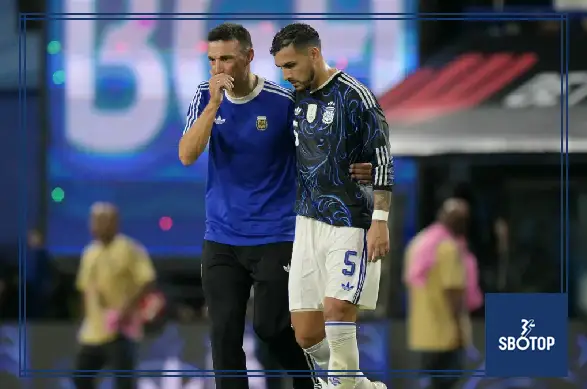
Argentina’s passage into the 2026 World Cup semi-finals produced one of the tournament’s most revealing off-ball moments. It did not involve Lionel Messi, a spectacular goal or a controversial decision. Instead, television cameras captured head coach Lionel Scaloni and midfielder Leandro Paredes locked in an animated conversation during Argentina’s difficult quarter-final against Switzerland.
The clip spread rapidly across social media. Supporters initially treated the animated exchange as a mystery, with some joking that Paredes appeared to be coaching the coach. A widely circulated lip-reading interpretation later suggested something much more serious and valuable: the pair were attempting to solve a positional problem created by Switzerland’s centre-forward and build-up structure.
Rather than exposing conflict, the conversation offered a rare view of elite tactical decision-making in real time. It showed a senior player identifying a problem from inside the match, explaining how it affected his responsibilities and asking for a structural adjustment. Scaloni listened, questioned him and eventually agreed that another centre-back could provide the solution.
The wording has not been officially confirmed, so the lip-reading should be treated as interpretation rather than verified transcript. Even so, the gestures and later substitution made the tactical reading credible.
A Difficult Quarter-Final for the Champions
Argentina entered the quarter-final as defending world champions but were made to work hard by Switzerland. Alexis Mac Allister gave Scaloni’s side an early lead, yet the Swiss gradually imposed their physical strength and disrupted Argentina’s passing rhythm. Dan Ndoye equalised in the second half, and the contest remained tense until Breel Embolo was sent off following a VAR review.
Even against ten players, Argentina needed extra time to regain control. Julián Álvarez eventually restored the lead with a long-range strike before Lautaro Martínez sealed a 3-1 victory. The result sent Argentina into a semi-final against England, but the performance forced repeated adjustments.
The conversation with Paredes emerged from that difficulty. Switzerland’s movement was creating uncertainty between Argentina’s midfield and defensive line. Paredes, operating as the deepest midfielder, appeared concerned that he was being dragged away from the central zone where he organised possession and protected the defence.
What the Lip-Reading Interpretation Suggested
According to the interpretation circulated by Argentine media, Scaloni questioned which opponent Paredes meant. The midfielder gestured to show a Swiss centre-back moving outward while the striker occupied a nearby channel.
Paredes’ complaint was not simply that he had an opponent close to him. His concern was that following the movement forced him towards the right, leaving him with less control over Argentina’s build-up through midfield. As the holding midfielder, he wanted to remain connected to the ball, receive from the defenders and determine the direction of the next attack.
Scaloni reportedly responded that the striker was not Paredes’ direct marking responsibility. Paredes agreed, but that was precisely his point. The presence and movement of the Swiss forward were still forcing him to react, despite the player theoretically belonging to one of Argentina’s centre-backs.
The discussion then became solution-focused. Scaloni asked whether Paredes wanted the forward drawn wider or whether he needed another defender. Paredes indicated that he wanted a centre-back to remain responsible for the striker, allowing him to protect and control the midfield. The exchange reportedly ended with Scaloni agreeing to introduce Nicolás Otamendi.
The interpretation turned a seemingly heated conversation into a compact tactical meeting. Paredes was explaining the difference between being near an opponent and being responsible for him. That distinction is crucial in positional football, where a player can be manipulated by an opponent without technically man-marking him.
Why Paredes Was Worried About Losing the Midfield
Paredes’ value to Argentina comes from his ability to see the game from behind the ball. He offers passing angles to the centre-backs, changes the direction of possession and looks for vertical deliveries into advanced midfielders or forwards. When positioned centrally, he can also react quickly when the ball is lost.
If he moves too far towards one side, several problems appear. Argentina may lose their easiest central passing option. The distance between midfielders can increase, making short combinations more difficult. A turnover can also leave a direct route through the middle for the opposition.
Switzerland appeared to understand this. By positioning a forward near Paredes while allowing a defender to step or spread wider, they could create doubt over who should follow whom. If Paredes stayed central, Switzerland might find a player between the lines. If he moved outward, Argentina’s build-up and defensive balance could suffer.
The midfielder’s gestures suggested that he was not asking to avoid defensive work. He was asking for clearer distribution of that work. He wanted the centre-backs to manage the striker so he could continue performing the role that made Argentina function.
Scaloni’s Response Revealed Collaborative Leadership
The most important part of the clip was Scaloni’s willingness to listen. International managers have limited time with their squads, and tournament matches demand immediate decisions. A coach watching from the technical area sees the team’s overall shape, but a player inside the game experiences angles, pressure and opponent movement in a more direct way.
Scaloni did not dismiss Paredes or insist that the original instruction remain unchanged. He asked questions, tested the player’s explanation and searched for the simplest adjustment. That reflected Argentina’s collaborative environment.
Scaloni’s leadership has been built around humility, emotional intelligence and trust in experienced players. His staff includes former internationals Pablo Aimar and Walter Samuel, while his understated approach has consistently allowed the players to remain central to Argentina’s identity.
Paredes, meanwhile, has been part of Argentina’s successful cycle for years and possesses the confidence to speak honestly without necessarily undermining authority.
Strong leadership is not weakened when a player identifies a problem. It is strengthened when the coach can judge whether that information improves the team. The viral exchange suggested that Scaloni sees tactical management as a collective process rather than a one-way lecture.
The Otamendi Adjustment
Nicolás Otamendi’s later introduction gave supporters a visible connection between the conversation and Scaloni’s decision. The veteran offered another specialist to handle Switzerland’s central attacker and protect the penalty area.
By adding a centre-back, Argentina could reduce the need for Paredes to track movements outside his preferred zone. The adjustment also gave the champions more security against direct passes, crosses and second balls, all areas in which Switzerland had caused difficulties.
The circumstances had changed by the time Otamendi entered, particularly after Switzerland were reduced to ten players and the match moved into extra time. Therefore, it would be too simplistic to claim that the substitution resulted only from Paredes’ request. Coaches consider fatigue, game state, available substitutes and several conversations before making a change.
Nevertheless, the similarity between the interpreted discussion and the eventual adjustment made the clip compelling. It showed how an observation made earlier could remain useful when the match entered a new phase.
A Midfielder Thinking Like a Coach
The exchange also highlighted Paredes’ tactical intelligence. Deep midfielders frequently become extensions of the coaching staff because they operate near the centre of the team and see play developing in every direction.
Their responsibilities go beyond completing passes. They must recognise when a centre-back should advance, when a full-back needs cover, when the press is broken and when the team should slow the game. They also communicate constantly, directing teammates while adjusting their own position.
Paredes’ interpretation of the Swiss problem appeared to combine defensive and attacking concerns. He wanted protection from the forward’s positioning, but he also wanted to preserve Argentina’s ability to build through him. That dual awareness is a defining quality of elite holding midfielders.
The conversation resonated because on-field decisions rarely divide neatly into attacking and defensive categories. One movement can affect both phases at once.
The Risks of Treating Lip-Reading as a Transcript
Although the tactical explanation is convincing, the viral translation should not be presented as an official record. Broadcast footage may show only part of a speaker’s face, and gestures can be interpreted differently without sound or surrounding context.
Lip-reading is particularly difficult in a fast-moving sporting environment. The angle changes, people interrupt one another and familiar football phrases can resemble other words. Social-media accounts also tend to simplify complex conversations into neat narratives that are easier to share.
For that reason, the safest conclusion is that the clip appears to show a detailed positional discussion and that widely circulated interpretations connect it to the later defensive adjustment. It is not possible to guarantee every sentence unless Scaloni, Paredes or the Argentine federation confirms the wording.
This caution does not reduce the clip’s value. Even without a perfect transcript, their body language clearly shows two football professionals debating space, roles and movement rather than arguing emotionally.
Argentina’s Tactical Flexibility Under Scaloni
Argentina’s success under Scaloni has never depended on one permanent formation. His teams can use a back four or add another central defender. They can play with three central midfielders, a diamond or wider attacking roles. Lionel Messi remains the creative reference, but the structure around him changes according to opponents and match conditions.
Scaloni has previously explained that Argentina prepare their attacking structure together with their protection against counterattacks. His approach emphasises rapid recovery after losing possession, followed by a compact midfield shape when an immediate counter-press is impossible.
That flexibility helped Argentina recover from difficult moments during their 2022 title run and has remained important in 2026. Against Switzerland, the champions were not consistently fluent, yet they found a way to survive pressure and improve during extra time.
The Paredes conversation represented that broader identity. Argentina do not treat their starting shape as a fixed diagram. Players are expected to understand principles, recognise problems and adapt responsibilities while the match is unfolding.
Such flexibility can be risky if communication is poor. Constant changes may create confusion or hesitation. Argentina’s advantage is that many members of the squad have worked together through multiple tournaments and understand the language behind Scaloni’s adjustments.
Also Read:
- SBOTOP: Senegal’s World Cup Exit Sparks Chaos as Team Doctor Faces Questions Over Medical Background
- SBOTOP: Four Key Facts About Ivan Barton the Referee Set to Oversee France vs Spain After Showing 11 Yellow Cards
- SBOTOP: France Midfielder Coolly Dismisses Talk of Special Anti-Yamal Plan for World Cup Semi-Final