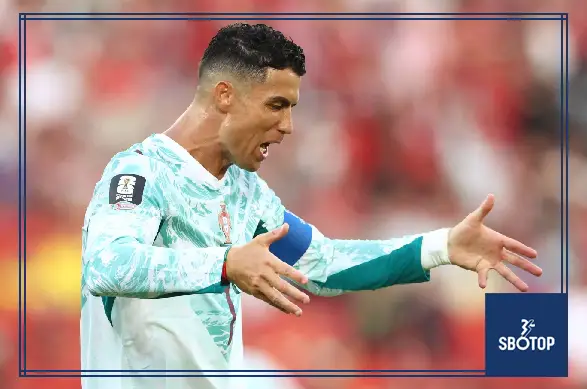
Cristiano Ronaldo has spent more than two decades answering questions about pressure, critics, records, responsibility and age. Yet even at 41, even after everything he has achieved, the question of retirement still follows him everywhere. Ahead of Portugal’s huge knockout clash with Spain at the 2026 World Cup, Cristiano Ronaldo once again found himself facing the subject that has surrounded the final chapter of his career: is this the last dance?
His answer carried the familiar sharpness of a player who has never liked being pushed toward an exit door. Ronaldo made it clear that he would decide his own future, not the media, not the critics, and not the passing of time. At the same time, he made a significant admission: the 2026 World Cup would be his final appearance on football’s grandest stage. Reports from the pre-match press conference noted that Ronaldo confirmed this would be his last World Cup while still resisting the idea that anyone else could dictate when he retires from the game entirely.
That combination summed up Ronaldo perfectly. He was emotional, but not defeated. Honest, but not resigned. Defiant, but not unrealistic. The Portuguese icon knows the World Cup clock has reached its final minutes for him, but he refuses to let the wider conversation become a farewell written by others.
The Weight of a Sixth World Cup
Very few footballers ever reach one World Cup. Fewer still become decisive figures across several. Cristiano Ronaldo presence at the 2026 tournament marked his sixth World Cup, extending a journey that began in 2006 when he was still a young, explosive winger trying to establish himself among the game’s elite. Two decades later, he arrived as a 41-year-old captain, global icon and living piece of football history.
That alone made the tournament feel historic. Ronaldo was not simply playing another competition; he was carrying the memory of an entire era. He had played through tactical changes, generational shifts, managerial cycles, and football’s transformation into an even faster, more physically demanding sport. His ability to remain part of Portugal’s plans at 41 was already a statement of discipline and endurance.
Ronaldo’s World Cup career has been filled with moments of brilliance, frustration and unfinished ambition. He delivered memorable goals, emotional celebrations and dramatic nights, yet the one trophy that remained beyond his reach was the one that matters most in international football. Reuters noted that Ronaldo’s World Cup story ended without the title he had chased throughout his career, despite a record-filled tournament history.
The Final World Cup Admission
The most striking part of Ronaldo’s message was not that he pushed back against retirement talk. That has been part of his identity for years. The bigger moment was his admission that this World Cup would be his last.
For a player who has always believed in extending limits, that admission carried emotional weight. Ronaldo has built his career on refusing to accept normal timelines. He has outlasted countless rivals, reinvented his game, and remained obsessed with preparation. But even he knows that another World Cup cycle would take him to an age where participation would be almost impossible.
Sky Sports reported that Ronaldo confirmed the 2026 edition would be his last World Cup as a player, adding that he wanted to enjoy it as much as possible. That detail matters. It showed that this was not simply a cold professional calculation. Ronaldo understood the emotional dimension of the moment. He knew each training session, each national anthem, each touch of the ball could be part of his final World Cup memory.
Still, he did not present himself as a man ready to disappear. He wanted to enjoy the stage, yes, but he also wanted to compete. For Ronaldo, sentiment has never replaced ambition.
Fighting the Retirement Narrative
Ronaldo’s relationship with criticism has always been intense. He has often used doubt as fuel. Every time questions were raised about whether he was slowing down, whether he could still decide games, or whether Portugal needed to move on, he seemed to treat those questions as another opponent.
That was the mood again when retirement came up. TNT Sports reported that Ronaldo acknowledged he was no longer the same player he once was, but insisted that retirement would happen only when he decided. That statement is central to understanding the late-career Ronaldo. He is not pretending to be 25. He understands that his role, body and rhythm have changed. But he rejects the idea that decline automatically removes his value.
This is why his response felt so personal. Retirement talk is not just a sporting question for Ronaldo. It touches his pride, his identity and his lifelong refusal to let others define his limits. He has been judged more heavily than most players because his standards were higher than most players could ever imagine. When someone asks when he will stop, he hears more than curiosity. He hears doubt.
And doubt, for Ronaldo, has always been a challenge.
Portugal’s Painful Exit Against Spain
The emotional weight of Ronaldo’s final World Cup became even heavier after Portugal’s knockout defeat to Spain. Reuters reported that Spain beat Portugal 1-0 in the Round of 16, with substitute Mikel Merino scoring a dramatic 91st-minute winner in Dallas. The result sent Spain into the quarter-finals and ended Ronaldo’s World Cup journey.
It was a cruel ending. There was no final miracle, no heroic late goal, no cinematic farewell. Instead, Portugal were eliminated by their Iberian rivals in one of the most painful ways possible: a tight match decided at the edge of stoppage time.
For Ronaldo, the defeat was more than another tournament exit. It was the closing of a World Cup chapter that had lasted 20 years. The applause that followed him could not hide the sadness of the moment. He had given almost everything to football, and the World Cup had given him fame, drama and records — but not the trophy.
That is part of the tragedy and beauty of Ronaldo’s story. Even the greatest players do not control every ending.
A Career of Records but One Missing Crown
Ronaldo’s career is almost impossible to summarize without sounding exaggerated. He has collected league titles, Champions League medals, individual awards, international trophies and scoring records that may stand for generations. With Portugal, he helped deliver the Euro 2016 title, the country’s first major international trophy, and later added Nations League success.
Yet the World Cup remained the one mountain he never conquered. That does not erase his greatness, but it does give his international story a bittersweet edge. Reuters highlighted the contrast clearly: for all his records, Ronaldo could not secure the World Cup crown before his final exit from the tournament.
Football history is full of legends whose careers contain one unresolved dream. Ronaldo now belongs to that group. But unlike many others, he leaves the World Cup stage with a record that reflects extraordinary longevity. Reports noted that he ended his World Cup career with 27 appearances and 11 goals, numbers that speak to both his durability and his ability to remain relevant across eras.
Still, Ronaldo’s legacy is not defined only by what he failed to win. It is also defined by how long he stayed in the fight.
The Human Side of the GOAT Debate
Ronaldo’s final World Cup also revived the endless debate about football greatness. Comparisons with Lionel Messi are unavoidable, especially because Messi lifted the World Cup with Argentina in 2022 while Ronaldo’s own pursuit ended without the same reward. But reducing Ronaldo’s career to that comparison is too narrow.
His story is different. Ronaldo is the symbol of relentless self-creation. He became great not only through natural talent, but through obsession, repetition and a constant hunger to improve. He transformed his body, his position and his style. He went from dazzling winger to devastating scorer, then from all-action forward to penalty-box predator.
The late-career version of Ronaldo may no longer carry the same speed or explosiveness, but he still carries aura. Opponents respect him. Teammates look to him. Stadiums react to him. Cameras follow him. Even when he does not dominate a match, his presence changes the atmosphere.
That is why retirement questions carry so much emotion. When Ronaldo eventually leaves the international stage completely, Portugal will not only lose a player. They will lose an era.
Why 2026 Felt Like a Farewell Tour
From the moment Ronaldo admitted this would be his final World Cup, every match became part of a farewell tour. Every close-up became symbolic. Every missed chance became heavier. Every celebration became more precious. The tournament was no longer only about Portugal’s progress; it was also about Ronaldo’s final attempt to write a golden ending.
That created a strange tension. On one hand, Portugal had to function as a team with modern tactical demands, younger stars and collective priorities. On the other, the emotional pull of Ronaldo’s final World Cup was impossible to ignore. His presence created motivation, but also attention. His story inspired, but also dominated headlines.
This is the challenge of having a legend in his final act. The team benefits from leadership and experience, but it also carries the weight of narrative. Every decision involving Ronaldo becomes bigger. Every substitution becomes a debate. Every result becomes part of his legacy.
Portugal’s defeat to Spain showed how ruthless football can be. The game does not always respect sentiment. Sometimes the final dance ends before the music reaches the chorus.
Also Read:
- SBOTOP: Reece James Fitness Concern Grows as Chelsea Star Misses England Training Before Mexico Clash
- SBOTOP: Mbappe Fires France Past Paraguay as Orlando Gill Handshake Snub Sparks Fiery Ball-Throwing Incident
- SBOTOP: Bruno Guimaraes Warns Brazil Must Shut Down Haaland as Odegaard Midfield Duel Looms in Norway Clash