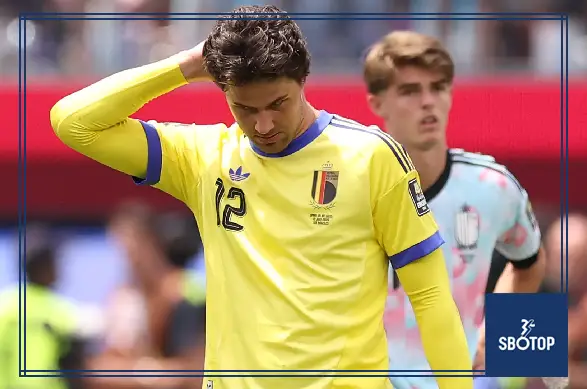
Belgium’s World Cup campaign ended with one of the cruellest sequences imaginable for a goalkeeper. With their quarter-final against Spain level at 1-1 and extra time approaching, substitute goalkeeper Senne Lammens failed to hold a low effort from Pau Cubarsí. Mikel Merino reacted first, drove the rebound into the net and sent Spain into the semi-finals with an 86th-minute winner. Lammens had entered the match only 15 minutes earlier after Belgium coach Rudi Garcia decided that Thibaut Courtois could not continue with a leg problem.
For Zlatan Ibrahimovic, the decisive error was not simply an unfortunate individual mistake. The former Sweden and Manchester United striker argued that the entire situation had been badly managed, directing his strongest criticism at Garcia and questioning why Lammens had been chosen ahead of Mike Penders.
Ibrahimovic’s assessment was characteristically uncompromising. He described Lammens as “overrated”, claimed Penders was the superior goalkeeper and said the decision to replace Courtois with the Manchester United player had cost Belgium the match.
Those words guaranteed headlines, but Belgium’s elimination cannot be understood through one error alone. The goalkeeper change became the defining moment because it arrived at the end of a match in which Spain had steadily applied pressure, Belgium had already lost key personnel, and Garcia had been forced to make an enormous judgement under World Cup conditions.
The result created three separate debates. Was Courtois truly unable to continue? Was Lammens the correct replacement? And was Ibrahimovic right to place such a large share of the blame on one young goalkeeper?
Courtois’ Injury Changed the Entire Match
Courtois began the quarter-final as Belgium’s most experienced and trusted defensive figure. The 34-year-old had been an important part of the national team for more than a decade and was one of the few remaining members of Belgium’s celebrated generation still playing a central role.
During the second half against Spain, Courtois felt discomfort while striking a long pass. He continued temporarily and made further saves, but the problem returned when he kicked the ball again. Courtois later explained that the injury did not prevent him from stopping shots, although it affected his ability to distribute over longer distances.
That distinction became central to the controversy.
Courtois believed he could have remained on the field for at least a little longer. Garcia took a different view. The coach had established a policy that players needed to be fully fit, and he did not want the goalkeeper’s condition to deteriorate. Belgium were also attempting to use long passes towards Charles De Ketelaere and later Romelu Lukaku, making Courtois’ reduced kicking range tactically significant.
In ordinary circumstances, replacing an injured player would be considered responsible management. In a World Cup quarter-final, removing one of the world’s most experienced goalkeepers with the score level becomes a decision of a completely different scale.
Garcia had to compare two risks. Keeping Courtois on could have worsened the injury or left Belgium unable to play their preferred passes. Taking him off meant exposing a much less experienced goalkeeper to the final stages of a tense knockout match.
The second risk eventually proved fatal.
Lammens Entered the Most Difficult Possible Situation
A substitute goalkeeper faces a challenge unlike almost any other replacement in football. An outfield substitute can spend several minutes running, pressing and making simple touches before becoming directly involved in a decisive moment. A goalkeeper may be required to produce a match-saving action immediately. Senne Lammens entered in the 71st minute. He had little time to adjust to the speed of Spain’s passing, the movement around the penalty area or the pressure created by the occasion. The match was level, Spain were pushing forward, and one error could decide Belgium’s entire tournament.
That is exactly what happened.
Cubarsí’s shot travelled low from distance. It was not an unstoppable strike, and Lammens reached the ball. The problem was that he did not secure it or push it safely away from danger. The rebound remained inside the penalty area, where Merino was already moving in anticipation.
Merino finished the opportunity, Spain celebrated and Lammens immediately understood the scale of the mistake.
This was not merely a league error followed by another match a week later. It was Belgium’s final meaningful action at the World Cup.
Zlatan Blamed the Selection Not Just the Save
Ibrahimovic’s criticism went beyond saying that Lammens should have held the shot.
He questioned why Garcia and Belgium’s goalkeeping staff had selected him ahead of Penders in the first place. Penders had spent the preceding season on loan at Strasbourg, while Lammens had become Manchester United’s first-choice goalkeeper.
Ibrahimovic suggested that club reputation may have influenced the hierarchy. He asked whether playing for Manchester United had given Lammens an advantage over a goalkeeper attached to a less globally famous club. His wider argument was that international selection should be based on current ability rather than the size of a player’s employer.
That was a provocative accusation because it challenged the competence of Belgium’s coaching staff.
The staff had worked with both goalkeepers throughout the tournament. They had observed their training, communication, distribution and reactions under pressure. Selecting Lammens as Courtois’ immediate deputy was therefore unlikely to have been a spontaneous decision made during the match.
Garcia would have entered the quarter-final already knowing which goalkeeper would replace Courtois if necessary.
Ibrahimovic nevertheless judged that hierarchy to be wrong. In his view, the outcome exposed a flawed evaluation process.
Was Calling Lammens “Overrated” Fair
Ibrahimovic’s language was powerful, but it was also severe.
Lammens was 24 years old and had just experienced a nightmare World Cup debut. He made an important technical mistake, but one mistake does not automatically prove that a goalkeeper lacks the quality to perform at international level.
His club form offered evidence in the opposite direction. After joining Manchester United from Royal Antwerp, he established himself as the club’s leading goalkeeper, started regularly and played an important role in a strong league campaign. Reports after Belgium’s elimination noted that he had built considerable goodwill at Old Trafford and was expected to receive support from United’s senior players when he returned.
Goalkeeping development is rarely linear. Young keepers make errors because the position demands constant judgement: whether to catch or parry, when to leave the line, where to direct a rebound and how to distribute under pressure.
The difference at international tournaments is that mistakes become part of history.
Lammens’ error will remain connected to Belgium’s 2026 elimination, regardless of what he achieves later. That does not mean it should define his entire career.
Courtois’ reaction offered a more sympathetic perspective. Rather than blaming his replacement, he embraced Lammens after the match and publicly backed him to recover. Courtois understood the isolation of the position and recognised that the younger goalkeeper would already be carrying enough responsibility.
Penders Became the Perfect Alternative in Defeat
One difficulty with post-match criticism is that the unused option always appears safer.
Because Penders remained on the bench, nobody can know how he would have handled the final 20 minutes. He might have caught Cubarsí’s shot cleanly. He might also have made a different error, struggled with Spain’s pressing or failed to communicate effectively with Belgium’s defenders.
The alternative exists only in imagination.
Ibrahimovic considered Penders the better goalkeeper, but Belgium’s coaches had placed Lammens above him in the tournament hierarchy. That judgement was based on more information than the public could see, including training performances and tactical suitability.
Even so, the criticism will remain powerful because the chosen goalkeeper made the decisive error.
Had Lammens saved the shot and Belgium advanced, the decision to introduce him might have been praised as calm and courageous. Because Belgium lost, every part of the selection process became open to examination.
Football often evaluates decisions through outcomes, even when the original logic may have been reasonable.
Garcia’s Philosophy Came Under Fire
Garcia defended the substitution by pointing to a principle he had followed throughout the World Cup: players needed to be fully fit.
He did not want Courtois attempting to survive the final stages while managing a muscle problem. He also believed Belgium required a goalkeeper capable of playing long passes without restriction. Garcia therefore insisted that he had no regrets about making the change.
That defence did little to reduce the criticism in Belgium.
Commentators questioned whether such a strict policy should have been applied to a goalkeeper of Courtois’ experience. Unlike an outfield player, Courtois was not required to sprint repeatedly or cover large distances. His injury appeared to affect long kicking more than shot-stopping.
Critics argued that Belgium could have adjusted their distribution instead of removing their best goalkeeper. Defenders might have taken goal kicks, or the team could have played shorter passes for the remaining minutes.
Garcia chose to protect the player and preserve his tactical plan. The result made the decision appear rigid rather than responsible.
Spain Had Already Earned the Right to Create the Error
Focusing entirely on Belgium’s goalkeepers risks ignoring Spain’s contribution.
Spain controlled much of the ball, pressed aggressively and repeatedly forced Belgium to defend around their own penalty area. Reports from the quarter-final credited Spain with approximately 68 per cent possession and highlighted their ability to regain the ball quickly after losing it.
Fabián Ruiz gave Spain the lead in the first half before De Ketelaere equalised for Belgium. The match remained competitive, but Spain continued to push for a winner rather than simply accept extra time.
The decisive move reflected that persistence.
Cubarsí stepped forward and attempted the shot. Merino followed the ball rather than assuming the goalkeeper would hold it. When Lammens spilled the effort, Spain had a player ready to punish the mistake.
Goalkeeping errors are often described as gifts, but opponents must still create the situation and react quickly enough to benefit.
Merino did both.
Merino’s Late-Game Impact Was No Accident
The winner also continued Merino’s extraordinary influence as a substitute.
He had already scored a late knockout goal against Portugal before repeating the achievement against Belgium. His ability to enter matches, understand the available spaces and attack the penalty area had become a major weapon for Spain.
Merino’s positioning was especially important against Lammens.
A less alert player might have watched Cubarsí shoot and remained outside the six-yard area. Merino anticipated the possibility of a rebound, accelerated into the space and gave the goalkeeper no opportunity to recover.
That is why Belgium’s defeat cannot be reduced entirely to a goalkeeper substitution. Spain had the squad depth, tactical aggression and concentration to exploit one imperfect action.
Lammens made the error. Spain ensured it became decisive.
Belgium Were Also Weakened Elsewhere
Courtois was not Belgium’s only problem.
Captain Youri Tielemans withdrew during the warm-up, removing an important midfielder before the match had even begun. Belgium then lost Courtois in the second half and had to manage Spain’s sustained pressure with an increasingly disrupted structure.
The team still competed well. De Ketelaere scored, Jérémy Doku carried a threat in transition and Belgium kept the game level until the closing minutes.
However, losing experienced players reduced Garcia’s control over the contest.
Belgium’s tournament had already included uneven performances. They drew with Egypt and Iran during the group stage, survived a difficult knockout match against Senegal and then produced an impressive 4-1 victory over the United States. Garcia met the official target of reaching the quarter-finals, but questions about his tactical decisions had followed the team throughout the competition.
The Spain defeat therefore became more than a single painful result. It intensified an existing debate about whether Garcia was the right coach to lead Belgium’s next cycle.
Also Read: