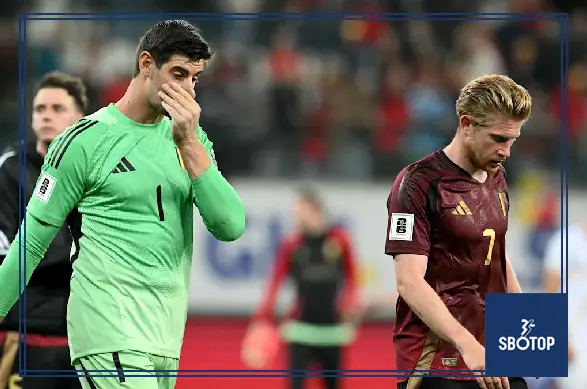
Belgium’s 2026 World Cup ended with defeat, tears and two of the country’s most important footballers refusing to guarantee that they would ever wear the national shirt again.
Kevin De Bruyne and Thibaut Courtois both left their international futures unresolved after Belgium’s 2-1 quarter-final loss to Spain. The result ended another attempt to transform one of the most talented eras in Belgian football into a major international trophy.
De Bruyne, now 35, said he needed rest after several physically punishing seasons and a major operation. He stopped short of declaring his retirement, but his request for a break made it clear that continuing with Belgium could no longer be treated as automatic. Courtois went further, proposing that he step away from the Nations League for approximately a year before potentially returning for the Euro 2028 qualifying campaign. The goalkeeper admitted that discussions with the Belgian federation and head coach would determine whether he remained available.
Their uncertainty has placed Belgium at a crossroads.
For more than a decade, De Bruyne and Courtois have represented the intelligence, ambition and elite quality of a generation expected to transform the country into a champion. They have played in major tournaments, carried enormous expectations and remained influential even as several celebrated teammates disappeared from the international stage.
Now Belgium must consider a future in which neither of them is present.
A Painful Ending Against Spain
Belgium’s quarter-final defeat was especially difficult because the team remained competitive until the closing minutes. Spain opened the scoring through Fabián Ruiz before Charles De Ketelaere equalised, giving Belgium renewed belief. The match appeared to be heading towards extra time until Mikel Merino reacted first to a rebound and scored the decisive goal late in the second half.
The circumstances surrounding that winner made the defeat even more emotional.
Courtois had been removed in the 71st minute after feeling discomfort in his leg while attempting a long kick. He believed that he could continue making saves, but head coach Rudi Garcia insisted on using a goalkeeper who was fully fit. Senne Lammens replaced him, then failed to hold Pau Cubarsí’s low effort. Merino collected the loose ball and finished the opportunity.
Courtois watched the decisive moment from the bench. Once the match ended, he put his own disappointment aside and consoled Lammens, recognising the emotional isolation that comes with a costly goalkeeping error.
It was an act of leadership from a player who knew the match may have been his final appearance for Belgium.
De Bruyne’s farewell, should it prove to be one, was less dramatic visually but equally significant. He completed his 124th international appearance without being able to control the match in the way he had so often done during his peak years. Spain’s possession, pressure and midfield structure prevented Belgium from consistently placing their most creative player in decisive areas.
Belgium did not collapse. They were not embarrassed. They competed bravely against one of the strongest teams in the tournament.
That may make the ending harder to accept.
De Bruyne Needs Time Before Deciding
De Bruyne’s comments after the defeat reflected physical exhaustion rather than a sudden loss of affection for the national team. He explained that the previous few years had been demanding and referenced the serious surgery he had undergone. Although proud that he had recovered sufficiently to represent Belgium at another World Cup, he was unwilling to make a major career decision immediately after elimination.
When asked whether the Spain match had been his last international appearance, De Bruyne indicated that he did not necessarily believe so. However, he wanted to step away, recover and consider his position after a difficult year.
That response left the door open without offering any commitment.
For supporters, the uncertainty will feel uncomfortable because De Bruyne has been central to Belgium’s footballing identity. His passing range, ability to accelerate attacks and understanding of space made him the natural creative leader of the team.
Yet the demands of international football extend beyond matches. Players must travel during club breaks, adapt to different systems and complete additional training sessions at a time when their bodies would otherwise be recovering.
For a 35-year-old who has endured significant physical setbacks, every international window now carries a measurable cost.
The question is no longer simply whether De Bruyne remains good enough to represent Belgium. His quality is not in doubt.
The question is whether his body and motivation can justify continuing through another two-year cycle.
Courtois Proposes a Different Solution
Courtois’ position appears more complicated.
Unlike De Bruyne, he did not speak only about needing an undefined period of rest. The Real Madrid goalkeeper suggested a more structured arrangement: missing the Nations League, taking approximately a year away from the national team and then returning for the European Championship qualification campaign.
He still appears interested in playing at Euro 2028. However, he acknowledged that the Belgian federation and coaching staff must accept his proposed schedule. If they want a goalkeeper who is continuously available throughout the cycle, Courtois may have to decide whether his international career is over.
That creates a difficult issue for Belgium.
Courtois remains an exceptional goalkeeper, and his performance against Spain demonstrated his importance. Before leaving the field, he had made several saves and helped keep Belgium in the contest. Replacing that level of experience would not be simple.
At the same time, a national team must build continuity. Coaches may be reluctant to develop another goalkeeper through the Nations League only to remove him once Courtois becomes available again.
Belgium must decide whether accommodating a senior star is the best path towards Euro 2028 or whether the next cycle should begin with a permanent transition.
Courtois has offered a possible compromise. The federation must determine whether that compromise works for the team.
The End of the Golden Generation
The uncertainty surrounding De Bruyne and Courtois has revived a familiar phrase: the end of Belgium’s golden generation.
For years, Belgium possessed a collection of players spread across Europe’s strongest clubs. Courtois protected the goal. De Bruyne organised the attack. Eden Hazard provided invention, Vincent Kompany led the defence and Romelu Lukaku supplied power and goals.
That group produced memorable performances and raised Belgium’s status in international football. Its deepest World Cup run came in 2018, when the team finished third.
But the major trophy never arrived.
The departures happened gradually rather than all at once. Some players retired, others suffered injuries, and several lost their influence as younger alternatives emerged.
De Bruyne and Courtois became two of the last remaining symbols of that era. Their possible departures would not simply remove two experienced players. They would close the clearest remaining connection between Belgium’s present and the generation that once appeared capable of dominating international football.
The label “golden generation” can be unfair. It measures success almost exclusively through trophies and can make years of consistency appear meaningless.
Belgium did not win a World Cup or European Championship, but the generation changed expectations around the national team. Reaching major tournaments became normal. Beating leading nations no longer felt extraordinary. Belgian players became some of the most respected figures in world football.
Their failure to win a trophy is part of the story, but it is not the entire legacy.
De Bruyne’s Influence Cannot Be Replaced by One Player
Belgium’s greatest challenge after De Bruyne will not be finding another midfielder with his exact qualities.
Such players rarely exist.
The more realistic task is to redistribute his responsibilities.
For much of his international career, De Bruyne could advance the ball, create chances, deliver crosses, shoot from distance and control the tempo. His presence allowed Belgium to build an attack around one extraordinary decision-maker.
The next version of the team may need to operate differently.
Youri Tielemans can control possession and offer leadership. Nicolas Raskin can provide energy and aggression. Jérémy Doku can carry the ball through pressure, while De Ketelaere can connect midfield with attack.
None of them is De Bruyne.
Together, however, they may create a more balanced structure in which creativity is shared rather than concentrated.
That transformation will require patience. The temptation will be to identify one young player as the new De Bruyne and burden him with an impossible comparison.
Belgium should resist that approach.
The national team’s future must be built around the strengths of the players available, not around recreating a footballer who may never be replicated.
Courtois Leaves an Equally Large Shadow
Replacing Courtois could be just as difficult.
Goalkeepers develop through trust, repetition and the knowledge that one mistake will not immediately remove them from the team. Belgium have promising options, but the World Cup defeat demonstrated how demanding the transition could become.
Lammens entered the Spain match in an almost impossible situation. He had little time to adjust, faced immediate pressure and made an error that decided a quarter-final.
That moment should not define his future. Courtois himself stressed that Lammens remained an excellent goalkeeper who could grow stronger from the experience.
Nevertheless, becoming Belgium’s permanent number one would place Lammens or any alternative under constant comparison with Courtois.
Every save would be expected. Every error would trigger questions about whether the veteran should return.
That is one reason Belgium need clarity.
A temporary Courtois break may preserve an elite goalkeeper for Euro 2028. It may also delay the point at which his successor gains full authority.
There is no perfect answer. The federation must choose between short-term excellence and the certainty required for long-term development.
Also Read: