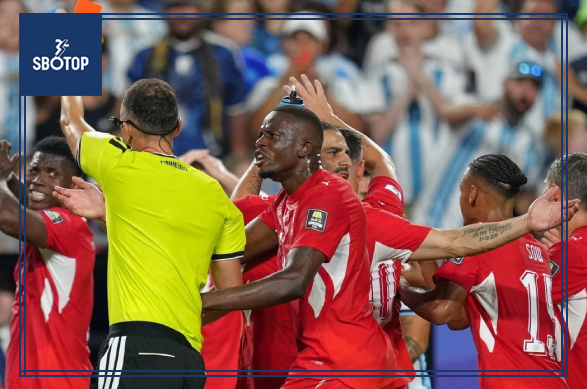
Switzerland’s dramatic 1-3 extra-time defeat to Argentina in the 2026 FIFA World Cup quarter-finals has been overshadowed by a controversial refereeing decision involving Breel Embolo. The Swiss forward was sent off after receiving a second yellow card following a VAR review, a moment that has reignited global debate over how far video technology should influence decisions on the pitch.
The incident has divided football fans, pundits, and former referees alike, with many questioning whether the Video Assistant Referee (VAR) exceeded its intended role by effectively changing both the player involved and the nature of the offence.
While Argentina eventually booked their place in the semi-finals thanks to extra-time goals from Julian Alvarez and Lautaro Martinez, much of the post-match discussion centered on the controversial dismissal that left Switzerland with 10 men during the decisive stages of the contest.
VAR Review Changes the Course of the Match
The controversy unfolded in the 71st minute when referee Joao Pinheiro was instructed to review an incident involving Breel Embolo and Argentina midfielder Leandro Paredes.
Initially, Paredes was shown a yellow card for what appeared to be a foul during the challenge. However, after consulting the pitch-side monitor and receiving guidance from the VAR team, the Portuguese official overturned his original decision.
Instead of cautioning Paredes, the referee ruled that Embolo had simulated the incident in an attempt to win a foul. The Swiss striker was consequently shown a second yellow card, resulting in his dismissal.
The decision forced Switzerland to play the remainder of normal time and the entire extra-time period with only ten players, significantly altering the balance of the match.
Argentina capitalized on their numerical advantage by scoring twice in extra time to secure a 3-1 victory and a place in the last four of the tournament.
Former FIFA Referee Questions VAR’s Interpretation
Former FIFA referee Christina Unkel was among the most prominent voices to criticize the decision.
Speaking after the match, Unkel argued that FIFA applied the mistaken identity protocol in a situation that should instead have been treated as a simulation review, creating confusion over the correct use of VAR.
“The decision involving Embolo is consistent with the earlier Almiron incident. FIFA appears to be treating these situations under the mistaken identity protocol, when in reality VAR is recommending punishment for simulation.”
She added that the most controversial aspect was not simply changing the player receiving the caution, but also changing the nature of the offence itself.
“The real issue is that VAR didn’t just identify a different player. It effectively changed the type of offence. At that point, we’re moving beyond correcting clear errors and entering territory where the referee is re-officiating the game.”
Her comments have fueled wider discussions about whether current VAR protocols need greater clarification ahead of future FIFA competitions.
Granit Xhaka Believes the Decision Changed Everything
Switzerland captain Granit Xhaka also expressed his frustration after the final whistle.
Although he acknowledged that the referee acted within the current Laws of the Game, Xhaka felt the dismissal fundamentally altered the contest at a crucial stage.
“Those are the rules, but in my opinion, that decision killed the match,” Xhaka said.
The Swiss captain’s disappointment was understandable, as his side had just regained momentum after Dan Ndoye scored the equalizer that brought Switzerland back into the game.
Reduced to ten men, Switzerland struggled to maintain the same defensive intensity and attacking threat against the reigning world champions.
Similar Incident Raises More Questions About Consistency
The Embolo controversy has quickly drawn comparisons with an earlier World Cup incident involving Miguel Almiron during the United States’ match against Paraguay.
In both cases, referees initially punished one player before VAR intervention led to a completely different outcome, with another player ultimately receiving a yellow card for simulation.
The similarities between the two incidents have prompted renewed debate over consistency in VAR implementation and whether the technology is being used beyond its original purpose of correcting “clear and obvious errors.”
VAR Debate Set to Continue
Although Argentina ultimately celebrated qualification for the 2026 FIFA World Cup semi-finals, the controversy surrounding Breel Embolo’s dismissal is likely to remain one of the tournament’s biggest talking points.
Supporters of VAR argue that technology exists to ensure correct decisions are made, regardless of how unusual the process may appear. Critics, however, believe interventions like this risk undermining the authority of on-field referees and changing matches in ways that extend beyond the original intention of video review.
With football’s governing bodies expected to review controversial moments after every major tournament, the Embolo incident could become another significant case study in the ongoing evolution of VAR and its role in the modern game.
ALSO READ :
- SBOTOP: Erling Haaland’s Quiet Night Explained After Illness Forces Norway Star Off Against England
- SBOTOP: Harry Kane Backs Thomas Tuchel While Admitting England Have Yet to Reach Their Peak at World Cup 2026
- SBOTOP: Kylian Mbappe Eases Injury Fears as France Star Laughs with Thierry Henry and Michael Olise Before Spain Semi-Final