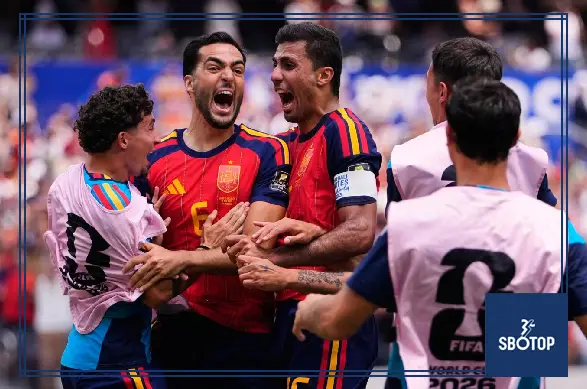
Mikel Merino’s defining image at the 2026 World Cup is not the mobility scooter he needed during the darkest stage of his recovery. It is the sight of him racing toward Spain’s supporters after another late winning goal, arms spread, teammates chasing and an entire tournament suddenly reshaped by his instinct.
Only months earlier, the Arsenal midfielder’s participation had been uncertain. A stress fracture in his foot, suffered in January, left him unable to walk for two months. Merino relied on a mobility scooter while his teammates continued their season, and he did not return to training until May. His recovery was therefore not merely a race for fitness. It was a test of patience, identity and belief during a period when the World Cup seemed capable of moving ahead without him.
Instead of allowing the injury to consume him, Merino treated rehabilitation as another form of preparation. He worked on the physical areas he could still improve, protected his mentality and focused on returning as a more complete player. That response now feels inseparable from what he has achieved for Spain. His decisive tournament moments have depended on the same qualities required during recovery: calmness, concentration and the willingness to act when an opportunity finally appears.
A World Cup Place That Once Looked Uncertain
Merino entered 2026 as one of Spain’s most dependable and tactically flexible players. Yet a serious foot problem changed the direction of his season at Arsenal and threatened his availability for the summer tournament. Being unable to walk for such an extended period placed him far behind teammates who were building rhythm through domestic and European competition.
Merino managed to return quickly enough to earn his place, although Spain planned to manage the minutes of players arriving from injury. Luis de la Fuente had already acknowledged before the tournament that travel, fatigue and the additional knockout round would require rotation. Merino’s recovery allowed him to become part of that strategy rather than another important name missing from the squad.
The reduced role might have frustrated another player. Merino had been a decisive figure for Spain before and had proved capable of influencing major matches from the starting lineup. At this World Cup, however, he started only once before the semi-finals. His greatest responsibility became waiting, studying the contest and entering when the game required a different solution.
Six Minutes to End Portugal’s Resistance
Spain’s round-of-16 meeting with Portugal appeared destined for extra time. La Roja controlled much of the second half but repeatedly failed to break through a disciplined defensive line. Diogo Costa made important saves, Portugal protected the central spaces and Cristiano Ronaldo’s final World Cup remained alive as the clock passed 90 minutes.
Merino had entered for Dani Olmo in the 85th minute. Six minutes later, he settled the match.
The move reflected the intelligence that defines his game. Merino restarted play quickly with a short free kick, then continued forward instead of admiring the pass. Ferran Torres received possession and found him drifting unmarked near the edge of the penalty area. Merino guided his finish into the bottom corner, giving Spain a 1-0 victory and ending Portugal’s campaign.
The goal was not produced by spectacular dribbling or overwhelming speed. It came from awareness. Merino recognised that Portugal’s defenders had followed the ball and temporarily lost track of his movement. By starting the attack and then entering the space it created, he turned a routine restart into the defining action of the tie.
Another Wait, Another Winning Goal
Scoring against Portugal did not earn Merino an immediate starting place against Belgium. It did not even bring an early introduction from the bench.
Spain’s quarter-final was level at 1-1 after Fabián Ruiz’s opener and Charles De Ketelaere’s equaliser. La Roja controlled possession and produced 17 shots to Belgium’s five, but Thibaut Courtois had made several excellent saves before leaving injured. His replacement, Senne Lammens, faced growing Spanish pressure as the match approached extra time.
Merino remained on the bench until the 86th minute, becoming Spain’s final substitute. Some players might have interpreted that delay as a lack of trust after deciding the previous match. Merino instead entered ready to influence whatever time remained.
He required less than two minutes.
Pau Cubarsí struck a low shot that bounced awkwardly in front of Lammens. The goalkeeper failed to secure it, and Merino reacted before the surrounding defenders. He had already moved toward the danger area, anticipating that a rebound might appear. When it did, he finished decisively to give Spain a 2-1 lead in the 88th minute.
The winning goal arrived only 117 seconds after Merino entered. Across the knockout victories over Portugal and Belgium, he received just nine minutes of normal playing time plus stoppage time, yet scored the decisive goal in both matches. He became the first player in World Cup history to register winners in two separate knockout ties as a substitute.
Preparation Disguised as Good Fortune
Late winning goals often attract language about luck, destiny and coincidence. Merino rejects that interpretation.
After eliminating Belgium, he argued that repeated moments are more likely to occur when a player enters properly prepared. His point was not that every rebound can be predicted. It was that readiness determines who reaches the unpredictable ball first.
Against Belgium, Merino did not wait outside the penalty area for a clean passing option. He moved toward goal as Cubarsí prepared to shoot. That choice placed him close enough to punish Lammens’ mistake. Against Portugal, he did not stop after taking the free kick. He continued into the space that developed and trusted Torres to return the ball.
The mobility-scooter period adds another layer to that mentality. Rehabilitation trained him to work without immediate reward. For weeks, progress was measured through small physical improvements rather than goals or appearances. At the World Cup, he has applied similar patience. He may wait 85 minutes, but he remains mentally connected to the contest because one movement can still justify the entire evening.
The Big-Moment Pattern Began Earlier
Merino’s World Cup heroics are dramatic, but they are not isolated from the rest of his career.
At Euro 2024, Spain’s quarter-final against Germany had reached the penultimate minute of extra time when Merino attacked a cross and scored with a powerful header. The goal sent Spain through, and La Roja eventually defeated England in the final to become European champions.
His Arsenal career has strengthened the same reputation. Since joining from Real Sociedad in 2024, he has been used as a conventional midfielder, an advanced runner and a makeshift centre-forward. He has scored against major opponents, and nearly all of his Premier League goals for the club have either equalised matches or put Arsenal ahead.
That hybrid quality is particularly useful late in tournament matches. Spain can preserve their passing structure while adding someone capable of turning crosses, rebounds and broken sequences into goals.
Merino does not operate like a conventional striker, but he understands the spaces strikers are expected to attack. His midfield background helps him anticipate how moves will develop, while his physical strength allows him to challenge defenders once he enters the penalty area.
This combination explains why so many of his goals feel timely rather than accidental. Merino rarely waits beside a centre-back hoping for a chance. He begins deeper, observes the movement ahead of him and arrives when defenders have shifted their attention elsewhere.
Why Merino Works So Well as a Substitute
Calling Merino a “super-sub” can sound reductive because he is capable of starting for elite teams. Yet the role suits several of his strongest characteristics.
When he enters late, opponents have already spent an hour or more chasing Spain’s possession. Their midfielders are slower to recover, their defenders become increasingly focused on the ball, and the spaces around the penalty area expand. Merino arrives with the physical strength and concentration to exploit that fatigue.
His movement also differs from Spain’s smaller creative midfielders. Pedri and Olmo frequently seek pockets between the lines, while Rodri controls the match from deeper positions. Merino is more likely to continue his run beyond the ball and appear alongside the forwards. That changes the reference points for defenders who have spent most of the game tracking different patterns.
De la Fuente has repeatedly emphasised the importance of players who accept responsibilities from the bench. His trust in Merino is especially strong because they have worked together since Spain’s youth levels. The coach has called him world-class and portrayed him as a dependable answer when matches become difficult.
The tactical benefit is significant. Spain do not need to abandon their identity when Merino enters. He can participate in possession, press opponents and protect the midfield. At the same time, he gives the team another target for crosses and another runner capable of reaching rebounds.
That makes him more valuable than a specialist substitute introduced for only one purpose. Merino can help Spain control a match, chase a goal or defend an advantage. His role changes according to the score, but his concentration remains constant.
Recovery Changed the Meaning of the Tournament
For Merino, every appearance in this World Cup carries significance beyond normal competition.
In January, he was facing surgery, immobility and uncertainty. By May, he had returned to training. Weeks later, he was scoring two of the most important goals in Spain’s modern World Cup history. The speed of that transformation makes his performances remarkable, but the emotional distance between those moments matters even more.
His response was to protect the parts of his career he could still control. He chose constructive work over self-pity and returned with an appreciation for limited opportunities. That mindset may explain why a place on the bench has not reduced his intensity.
He knows that simply being available was never guaranteed.
What makes the transformation especially powerful is its speed. Merino did not return with months to rebuild confidence through routine club matches. He moved almost directly from rehabilitation into the demands of international tournament football. Every sprint, collision and late run therefore carried a reminder of the work completed away from cameras, when progress meant standing, walking and trusting his foot again.
The injury could have left him physically cautious. Instead, his winning goal against Belgium required him to attack a crowded area where a collision was possible. His header against Germany in 2024 and his repeated willingness to challenge centre-backs demonstrate a player who refuses to let fear control his movement.
Spain’s Saviour Without Seeking the Spotlight
Merino has become the unlikely central figure of Spain’s campaign because knockout tournaments reward decisive timing.
He did not dominate Portugal for 90 minutes. He decided the match in one move. He did not control the quarter-final against Belgium. He arrived for 117 seconds and changed Spain’s destination.
That does not mean he carried Spain alone. Both goals emerged from collective attacks, and La Roja’s control created the conditions for late pressure. But Merino supplied the final action that separates an impressive performance from actual progression.
This distinction matters at a World Cup. Teams can dominate possession, create chances and receive praise for their football, but elimination reduces all of it to a memory. Merino has repeatedly ensured that Spain’s control produces the only outcome that keeps a tournament alive.
His willingness to accept a supporting role also reflects the culture De la Fuente has attempted to build. Spain possess enough midfield talent for several established players to begin matches on the bench. Maintaining unity requires substitutes to view themselves as active participants rather than disappointed observers.
Merino has become the strongest example of that principle. His performances show every reserve player that a handful of minutes can carry the same importance as a starting appearance.
Spain had not reached a World Cup semi-final since winning the trophy in 2010. Merino’s rebound against Belgium ended that wait and sent them into a meeting with France. Spain entered the semi-final having conceded only once, while Merino had delivered the late decisive goals in their previous two matches.
Also Read: