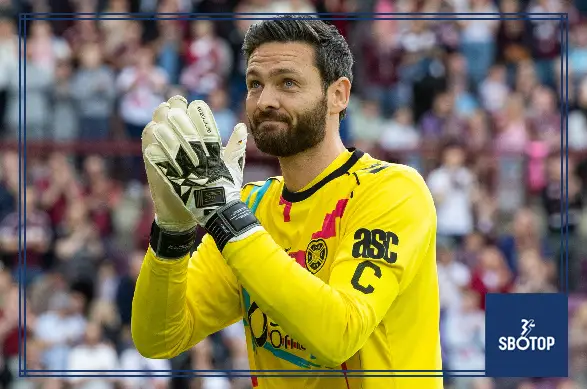
Craig Gordon has brought one of Scottish football’s most remarkable careers to a close, announcing his retirement at the age of 43 after 25 years in the professional game. The former Hearts, Sunderland and Celtic goalkeeper leaves football having made 682 club appearances and earned 84 senior caps for Scotland. His journey began with a loan spell at Cowdenbeath in 2001 and concluded after returning to his boyhood club, Hearts, where he had first developed as a young player. Gordon was also included in Scotland’s squad for the 2026 World Cup, becoming the oldest player selected for the tournament, although he served as Angus Gunn’s deputy and did not appear in a match.
For many players, longevity alone would represent an impressive achievement. Gordon’s career, however, cannot be properly explained through years, appearances or trophies. Its defining feature was his capacity to recover.
He overcame serious ankle problems, broken arms, knee surgery, nearly two years outside professional football and a double leg fracture suffered when he was already 39. Each setback appeared capable of ending his playing days. Each time, Gordon returned.
His final decision therefore closes more than a sporting career. It ends a story of persistence that repeatedly challenged conventional ideas about age, injury and what a footballer can achieve after being written off.
A Farewell Delivered with Gratitude
Craig Gordon announced his retirement through an emotional video released by Hearts. His message was reflective rather than regretful.
“I’ve never wanted it to end, but end it must,” he said, before expressing his gratitude for having fulfilled the childhood ambitions of representing Hearts and Scotland. He thanked teammates, coaches, medical staff, opponents, supporters and loved ones who had accompanied him through the different stages of his career.
The tone of the farewell suited the goalkeeper’s public personality. Gordon was rarely associated with controversy or extravagant statements. He generally allowed his performances, professionalism and recovery from adversity to speak for him.
His retirement message also highlighted how closely his identity remained connected to Hearts and Scotland. Even after winning numerous trophies with Celtic and competing in the Premier League with Sunderland, the two teams he had dreamed of representing as a child remained central to his story.
That emotional connection explains why ending his career at Hearts carried such meaning. Gordon did not simply return to a former club in 2020. He returned to the place where his ambitions had started.
The Beginning of a Lifelong Hearts Story
Born in Edinburgh in December 1982, Gordon developed through the Hearts youth system before beginning his senior career on loan at Cowdenbeath in 2001.
The spell provided him with an early introduction to the demands of professional football. Goalkeepers often face a difficult path into senior teams because only one can start, making first-team opportunities especially valuable. Gordon used his experience at Cowdenbeath to prepare himself for the pressure that awaited at Tynecastle.
He broke into the Hearts first team during the following season and quickly established himself as one of Scotland’s most promising young goalkeepers. His height, reflexes and composure were immediately noticeable, but his authority also developed rapidly.
Gordon was not merely a talented prospect protected by experienced defenders. He became a decisive figure capable of winning points through individual saves.
As his reputation grew, so did his importance to Hearts. He developed from academy graduate into first-choice goalkeeper, Scotland international and club captain.
The relationship between Gordon and the Hearts support was built on more than local identity. Fans saw a player who understood the club, had developed within its system and performed with the consistency required to compete against Scotland’s most powerful teams.
The Glory of the 2005–06 Season
The 2005–06 campaign became one of the defining periods of Gordon’s first spell at Hearts.
The Edinburgh club challenged the traditional dominance of Celtic and Rangers, finished second in the Scottish Premier League and secured qualification for the Champions League qualifying rounds. Hearts also won the Scottish Cup, defeating Gretna on penalties after the final finished 1-1.
For Gordon, the trophy represented the first major honour of his career. He had already built a reputation as one of the best goalkeepers in Scotland, but lifting silverware as a central figure in his boyhood club’s success elevated his status.
Sky Sports records that the Scottish Cup was the first of 15 major honours Gordon would collect during his career. He was later inducted into the Hearts Hall of Fame in 2007 at the age of 24, becoming the youngest player to receive that recognition.
That early induction reflected how highly he was already regarded. Gordon had not needed a long retirement period for supporters and club officials to recognise his importance. By his mid-20s, he had already secured a lasting place in Hearts history.
His performances were also attracting attention outside Scotland. Premier League clubs began monitoring him, and Sunderland eventually made a financial commitment that demonstrated his growing reputation.
A Record-Breaking Move to Sunderland
In August 2007, Gordon joined Sunderland for a reported £9 million. At the time, the fee represented a British transfer record for a goalkeeper.
The move placed him in one of the world’s most demanding leagues and brought expectations that matched the transfer fee. Sunderland had recently returned to the Premier League under Roy Keane and needed a goalkeeper capable of performing under sustained pressure.
Gordon regularly faced high shot volumes, physical contests and the unforgiving attention attached to English top-flight football. There were difficult moments, but he also produced saves that confirmed why Sunderland had invested so heavily in him.
The most celebrated came against Bolton Wanderers in December 2010. Zat Knight appeared certain to score with a close-range header, but Gordon moved across his goal and somehow pushed the ball away with one hand. The intervention was later named the best save in Premier League history as part of the competition’s 20th-anniversary awards.
The save remains an ideal demonstration of Gordon at his peak. It combined anticipation, explosive movement, reach and the refusal to accept that a seemingly certain goal was unavoidable.
Unfortunately, his Sunderland career also became the period when injuries began placing severe limits on his availability.
Injuries Turn Promise into Uncertainty
Gordon’s five years at Sunderland were disrupted by a succession of physical problems. Ankle injuries, broken arms and knee surgery repeatedly interrupted his attempts to build momentum.
He made 95 appearances for the club, but the number could have been considerably higher without those setbacks. By the end of his contract in 2012, concern had moved beyond whether he could return to his previous level. There were genuine doubts over whether he would play professionally again.
The period that followed would have ended many careers.
Gordon spent around two years without playing competitive football. At times, he could not walk without pain. He underwent rehabilitation, explored coaching and worked privately to determine whether his body could tolerate the demands of goalkeeping again.
For an outfield player, a long absence is difficult enough. For a goalkeeper, it can be especially damaging. Timing, confidence, reactions and decision-making all depend on regular exposure to match situations.
Gordon was also approaching his early 30s. Clubs could easily have considered him too great a medical risk, regardless of his previous quality.
The obvious path would have been retirement. Instead, he continued training and waiting for an opportunity.
Celtic Provide the Platform for a Stunning Comeback
That opportunity arrived in 2014 when Celtic signed Gordon following the departure of Fraser Forster.
The transfer initially appeared to be a calculated gamble. Gordon had pedigree, but he had not played a competitive first-team game for approximately two years. Celtic needed a goalkeeper capable of handling domestic expectations and European competition.
Gordon responded by rebuilding his career almost immediately.
His shot-stopping remained strong, while his calm temperament helped him deal with the pressure attached to representing a club expected to win nearly every domestic match. He became an important figure during a highly successful era at Celtic Park.
Across six seasons in Glasgow, Gordon accumulated league titles, Scottish Cups and League Cups. Sky Sports credits him with six Premiership titles, three Scottish Cups and five League Cups during his time with Celtic, while his overall career total reached 15 major honours when his earlier Hearts success is included.
The trophies were significant, but the comeback itself carried even greater meaning.
Gordon had moved from being unable to walk pain-free to playing European football and collecting domestic silverware. He did not simply return as a backup or sentimental signing. He reclaimed a place among Scotland’s leading goalkeepers.
His Celtic spell changed the way his career would be remembered. Without it, the story might have centred on exceptional talent damaged by injury. Instead, it became a demonstration of how an elite athlete could reconstruct a career after losing two crucial years.
Returning Home to Hearts
When Gordon’s Celtic contract expired in 2020, he returned to Hearts.
The club were then preparing to compete in the Scottish Championship following relegation. Gordon could have viewed the move as a comfortable final chapter, but his performances quickly showed that he had not returned merely to provide experience.
He became first-choice goalkeeper, captain and one of the team’s most reliable players. Hearts secured promotion back to the Premiership before re-establishing themselves near the top of Scottish football.
Gordon continued producing important saves well into his late 30s and early 40s. His positioning and understanding of the game compensated for any natural physical decline, while his professionalism set standards for younger teammates.
The second Hearts spell also deepened his connection with the support. Fans who had watched him develop as a young goalkeeper saw him return as an experienced international and serial trophy winner.
He had left Tynecastle as a record-breaking talent and returned as a senior leader.
Yet even this homecoming contained another injury that threatened to provide an abrupt and painful ending.
The Double Leg Break That Could Have Ended Everything
On Christmas Eve 2022, Gordon suffered a double leg break following a collision during Hearts’ match against Dundee United.
The images immediately caused concern. Gordon was 39, approaching 40, and facing another major operation followed by a lengthy rehabilitation process. There appeared to be little sporting logic in attempting another comeback.
He had already built a distinguished career. He had won trophies, represented Scotland and recovered from injuries that once left him without a club. Retirement would have been understandable.
Gordon chose to continue.
After surgery and months of rehabilitation, he returned to competitive football for Hearts. He also reclaimed a place in the Scotland setup, once again demonstrating the determination that had defined his career since the Sunderland years.
The comeback was extraordinary not because he returned as a symbolic substitute but because he again showed that he could perform at a high level.
Recovery from a serious fracture requires physical work, but Gordon also had to overcome the psychological challenge of diving, jumping and entering collisions without hesitation. Goalkeepers cannot protect themselves from every impact. They must commit to situations in which contact is inevitable.
His willingness to do so at that stage of his career revealed how strongly he still wanted to compete.
Eighty-Four Caps and a Lasting Scotland Legacy
Gordon made his senior Scotland debut in 2004 and went on to earn 84 caps across more than two decades.
That total placed him on the Scottish FA’s international roll of honour and established him as one of the most-capped players in the country’s history. He represented Scotland through several different managerial eras and competed with goalkeepers including David Marshall, Allan McGregor, Angus Gunn and others for the starting position.
His international career did not follow a simple upward path. Injuries removed him from contention during years when he might otherwise have added many more appearances.
His return to the national team therefore became another important element of his wider comeback. Gordon was not satisfied merely to resume club football with Celtic. He worked his way back into Scotland’s plans and again became trusted at international level.
Playing for Scotland was clearly one of the achievements he valued most. In his retirement message, he joked that he became slightly better at singing after 84 performances of the national anthem, while expressing gratitude for facing major opponents in famous stadiums.
His Scotland legacy should not be measured only by clean sheets or individual saves. Gordon provided continuity across generations.
Some of his international teammates were still children when he made his debut. By the time he entered his final squad, he was an experienced figure capable of advising players who had grown up watching him.
A Final World Cup Chapter at 43
Gordon’s inclusion in Scotland’s 2026 World Cup squad provided a fitting final chapter.
Scotland were competing at their first World Cup in 28 years, and Gordon was the oldest player among more than 1,250 footballers selected for the tournament. Although he did not play and served as backup to Angus Gunn, his presence carried considerable symbolic value.
Years earlier, Gordon’s career had appeared over because of chronic injury. He later suffered a double leg fracture at 39. Yet at 43, he travelled to the biggest tournament in international football as a member of his national squad.
He did not need to appear on the pitch for the achievement to matter.
Tournament squads depend on more than the starting eleven. Experienced players contribute during preparation, training and the emotionally demanding periods between matches. Gordon understood the pressure of international football and the expectations surrounding Scotland.
Being selected also confirmed that he remained physically capable of training at elite level. His place was not simply a reward for past service. Scotland’s coaching staff believed he could perform if required.
That World Cup call concluded the circle of a career built around refusing to accept that an ambition had passed.
Also Read: