Lionel Messi’s sixth World Cup ended with tears, defeat and an unexpected wave of criticism after the Argentina captain appeared to demand a red card for Spain defender Marc Cucurella during the closing stages of the 2026 final.
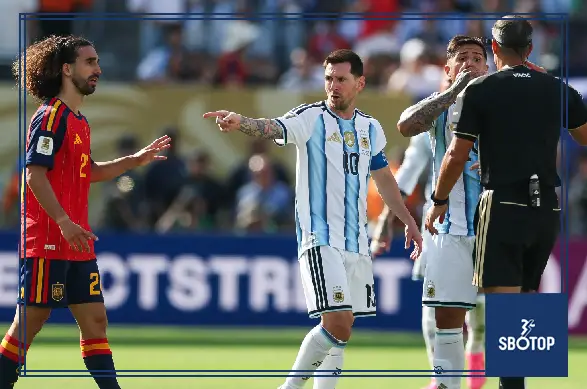
The controversial moment came shortly after Argentina midfielder Enzo Fernández had been dismissed near the end of regulation time. As Pau Cubarsí received treatment following Fernández’s late challenge, Cucurella approached Messi and briefly covered his mouth while speaking. Messi immediately drew the referee’s attention to the gesture, apparently arguing that the Spanish player’s conduct deserved further investigation and potentially the same punishment Argentina had just received.
No card was shown to Cucurella, and the match continued with Spain holding a numerical advantage. Ferran Torres eventually scored in the 106th minute to secure a 1-0 extra-time victory, giving La Roja their second World Cup crown and ending Argentina’s attempt to retain the trophy won in 2022.
Messi’s appeal might have lasted only a few seconds, but it quickly became one of the most debated incidents of the final. Former England players Wayne Rooney, Joe Hart and Lee Dixon criticised the 39-year-old’s reaction during television and radio coverage, describing it as a desperate attempt to exploit a controversial tournament regulation.
For a player celebrated throughout his career for producing moments of genius, the incident created an uncomfortable final image. Rather than discussing only Messi’s extraordinary achievement in leading Argentina to another World Cup final, viewers were also debating whether football’s most decorated star had tried to manufacture an opponent’s dismissal.
How the Incident Developed
The flashpoint occurred during a tense period in which Argentina’s control of their emotions was beginning to disappear.
Fernández had already been booked before launching into a late challenge on Cubarsí during second-half stoppage time. The referee produced a second yellow card, reducing Argentina to 10 men just before the contest entered extra time.
Spanish players gathered around Cubarsí while he received treatment. Cucurella then spoke to Messi with his hand briefly positioned near his mouth, a common gesture among players who do not want television cameras or lip-readers to capture their words.
Messi reacted immediately. He pointed toward Cucurella and appealed to the officials, appearing to suggest that the exchange should be reviewed under a new disciplinary approach discussed throughout the tournament.
The referee did not agree. Video officials also found no reason to intervene, and Cucurella remained on the pitch.
The lack of punishment intensified Argentina’s frustration, but there was no clear evidence publicly presented that Cucurella had used discriminatory or abusive language. The incident appeared to be no more than a short exchange during an emotionally charged interruption.
That distinction became central to the subsequent criticism. Messi was not attacked merely for speaking to the referee. Captains regularly ask officials for explanations. He was criticised because commentators believed he was attempting to turn an ordinary gesture into a red-card offence.
The Controversial Mouth-Covering Debate
Messi’s appeal did not emerge without context. According to broadcast reports, officials at the 2026 World Cup had taken a stricter approach to confrontational exchanges in which players covered their mouths. The policy was connected to efforts to identify discriminatory or seriously abusive language that could otherwise be concealed from cameras. Earlier tournament incidents involving Miguel Almirón and Piero Hincapié had reportedly resulted in dismissals after mouth-covered confrontations.
That background apparently encouraged Messi to believe Cucurella’s gesture could be punished.
However, covering the mouth alone did not automatically prove misconduct. Context, language and the confrontational nature of the exchange remained essential. Cucurella’s brief conversation did not appear serious enough for the referee or video officials to act.
This uncertainty made the episode difficult to judge solely from television pictures. Messi may have believed he had witnessed a technical offence under the tournament’s interpretation. Equally, his immediate and animated appeal made it look as though he was searching for any possible way to restore numerical equality.
Argentina had just lost Fernández. Spain were in control. Messi knew that playing extra time with 10 men would make an already difficult final even more demanding.
The timing therefore encouraged critics to interpret the appeal as tactical desperation rather than a genuine concern over Cucurella’s words.
Lee Dixon Delivers the Harshest Verdict
Dixon offered the most direct criticism during ITV’s coverage.
The former Arsenal and England defender argued that football would be moving in a dangerous direction if players could be dismissed simply for covering their mouths while talking. He then accused Messi of behaving like a “baby” and called the attempt to secure Cucurella’s dismissal ridiculous.
His language was deliberately blunt.
Dixon’s objection was not only about Messi. It reflected broader concern about players pressuring officials, exaggerating incidents and attempting to manipulate regulations for a competitive advantage.
In his view, Cucurella had not committed an obvious act of aggression. Messi’s response therefore represented an attempt to influence the referee rather than a reasonable request for protection.
The criticism was striking because of Messi’s reputation. Commentators often treat the Argentine with enormous respect, recognising both his ability and his generally controlled public personality. Hearing such a celebrated player described in childish terms demonstrated how negatively the incident had been received.
Dixon’s verdict also gave the controversy its most memorable phrase. Within minutes, the argument was no longer simply about an obscure disciplinary interpretation. It had become a debate about whether Messi had embarrassed himself on the biggest stage.
Rooney and Hart Also Disappointed
Rooney took a less aggressive but equally critical position.
The former England and Manchester United striker described Messi’s behaviour as sad to watch and interpreted it as evidence of Argentina’s desperation. Hart also said he disliked what he had seen, suggesting that Spain’s superiority had pushed even Messi toward conduct normally associated with a team losing emotional control.
Their reactions mattered because both understood the pressure of major international tournaments.
Players search constantly for small advantages. They appeal for throw-ins they know they did not win, surround referees after difficult decisions and attempt to influence the emotional direction of a match.
Rooney and Hart were therefore not expressing surprise that Messi spoke to the official. Their disappointment came from the apparent scale of the punishment he wanted.
A yellow card appeal might have been viewed as routine gamesmanship. Attempting to have an opponent removed for a brief covered-mouth conversation appeared excessive.
The criticism suggested that Messi had crossed an unwritten line. Competitive intelligence is accepted; manufacturing a dismissal is not.
Spain’s Control Increased Argentina’s Desperation
The incident cannot be separated from the way the final was unfolding.
Spain dominated possession, created almost every significant opportunity and prevented Argentina from producing a single attempt during regulation time. La Roja registered 20 shots before Argentina finally managed their first effort late in extra time.
Argentina’s plan had been based on survival.
Lionel Scaloni’s side defended compactly, attempted to disrupt Spain’s rhythm and relied heavily on Emiliano Martínez. The goalkeeper made 12 saves, keeping the score level despite sustained Spanish pressure.
Messi spent much of the final isolated from the areas where he could create danger. Spain surrounded him whenever he received possession and forced him to move deeper in search of the ball.
For more than 90 minutes, Argentina remained close to achieving their objective. A penalty shootout would have offered Martínez the opportunity to become decisive again.
Fernández’s red card damaged that strategy. Argentina were already struggling to escape their defensive third with 11 players. Losing a midfielder created more space for Spain and left Messi with even less support.
Seen through that context, the Cucurella appeal looked like the action of a captain who understood that his team was running out of conventional solutions.
Cucurella Refuses to Be Distracted
Cucurella’s response was notable for its simplicity.
He did not become involved in a prolonged confrontation, and there was no retaliatory gesture that gave the officials a reason to punish him. Once the referee rejected Argentina’s appeal, the Spanish defender returned his attention to the match.
That discipline reflected Spain’s broader performance.
Luis de la Fuente’s players refused to be drawn into Argentina’s emotional approach during the most important moments. They continued circulating possession, stretched the 10-man defensive block and waited for an opening.
The breakthrough finally arrived through two substitutes. Nico Williams helped direct the ball into a dangerous central area, where Torres reacted quickest and struck beyond Martínez.
Spain’s calmness contrasted sharply with Argentina’s growing frustration.
Cucurella remained available to contribute during extra time. Messi’s appeal failed, and the numerical disadvantage Argentina hoped to reverse ultimately played a part in Spain’s winning pressure.
Was the Backlash Too Severe
The criticism was understandable, but some of the reaction risked becoming disproportionate.
Messi did not physically attack Cucurella, invent an injury or cause the match to stop for an extended period. He saw a gesture that had reportedly been connected to previous disciplinary decisions and asked the referee to examine it.
Captains are expected to communicate with officials. Had Cucurella used abusive or discriminatory language, Messi would have been justified in reporting it.
The problem was the apparent absence of supporting evidence.
Television footage showed the covered mouth but could not establish what was said. Without clear misconduct, demanding a red card appeared opportunistic.
Messi’s status also magnified the response. A similar appeal from a less famous player might have disappeared within the broader story of the final. Every Messi gesture, however, is examined internationally.
The language used by some critics was therefore harsher than the incident itself required. Calling the appeal embarrassing was a legitimate opinion. Treating it as a defining moral failure would ignore more than two decades of professional conduct.
A Rare Stain on Messi’s Final World Cup
The controversy was especially unfortunate because the 2026 tournament had otherwise added another impressive chapter to Messi’s international career.
At 39, he scored eight goals, contributed four assists and helped Argentina reach a second consecutive final. Spain eventually neutralised him, but Argentina’s journey would have been far more difficult without his influence.
He also became one of only two male players to appear at six World Cups and participated in a third final, following Argentina’s defeats in 2014 and victory in 2022.
Those achievements will carry far greater historical importance than one unsuccessful appeal.
Nevertheless, the possibility that this was his final World Cup made the moment more uncomfortable. Supporters hoped to see Messi leave the competition with another display of brilliance or, at minimum, the dignity expected from a legendary captain.
Instead, his final match included frustration, an unsuccessful attempt to influence a major disciplinary decision and tears after Torres’ winning goal.
Messi did remain on the field after the defeat and received consolation from Spanish players, including Lamine Yamal. That emotional exchange offered a more fitting reflection of his legacy than the argument involving Cucurella.
Argentina’s Emotions Continue to Boil Over
The Cucurella episode was not Argentina’s only disciplinary problem.
Fernández’s dismissal left the defending champions with 10 men, while a confrontation erupted after the final whistle as Spain attempted to celebrate. Leandro Paredes became heavily involved and pushed Gavi to the ground before receiving a post-match red card. Scaloni entered the crowd of players to help calm the situation.
Together, those moments created an impression of a team whose emotional intensity had become destructive.
Argentina’s passion had been one of their greatest strengths under Scaloni. It helped unite the squad, survive difficult knockout matches and end the country’s long wait for international success.
Against Spain, the same emotion became increasingly difficult to control.
Messi’s appeal, Fernández’s challenge and the post-match confrontation were separate incidents, but they formed part of the same uncomfortable conclusion. Argentina could accept victories with enormous emotion; the final tested whether they could manage defeat with equal discipline.
Several players failed that test.
Gamesmanship Remains Part of Elite Football
The debate also raised a broader question about what supporters expect from elite players.
Footballers regularly attempt to influence referees. Defenders exaggerate contact to win free kicks. Attackers ask for penalties after minimal challenges. Goalkeepers delay restarts, and captains surround officials after controversial decisions.
These actions are often described as experience when they succeed and cheating when they fail.
Messi’s appeal belonged within that grey area. He recognised a possible interpretation of the regulations and tried to use it in Argentina’s favour.
From a purely competitive perspective, the logic was clear. If Cucurella had been dismissed, both teams would have entered extra time with 10 players.
From a sporting perspective, the attempt looked unattractive because the punishment sought appeared far greater than the apparent offence.
The strongest criticism was therefore not that Messi tried to help Argentina. It was that he attempted to help them by removing an opponent rather than through his football.
Also Read:
- SBOTOP: Toni Kroos Hails Spain’s World Cup Triumph as a Victory for Football While Criticising Argentina
- SBOTOP: Rodri Crowned World Cup’s Best Player Ahead of Messi as Spain Dominate Post-Final Honours
- SBOTOP: Tearful Lionel Scaloni Weighs Argentina Future as He Calls for Time to Make a Fair Decision