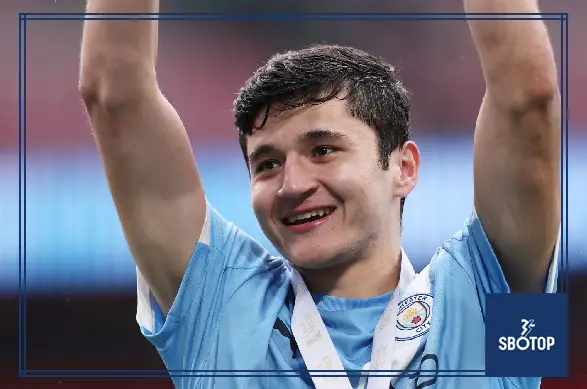
Manchester City have placed Abdukodir Khusanov at the heart of their long-term plans by handing the Uzbekistan international a new contract that will keep him at the Etihad Stadium until the summer of 2031.
The agreement represents a major show of confidence in a defender who arrived from Lens only in January 2025. Khusanov’s original four-and-a-half-year contract had been scheduled to expire in 2029, but his progress during his first 18 months in English football persuaded City to secure his services for an additional two seasons.
The timing is particularly significant. Khusanov’s extension has been confirmed as Manchester City enter a new era under Enzo Maresca, who has succeeded Pep Guardiola on a three-year contract running until 2029. Maresca returns to an organisation he knows well, having previously managed City’s Elite Development Squad and worked as Guardiola’s assistant during the club’s treble-winning 2022–23 campaign.
For Khusanov, the new deal provides security but not comfort. The 22-year-old has openly acknowledged that his next challenge is to convince Maresca and the new coaching staff that he deserves to play regularly. His comments reflected ambition rather than satisfaction, making it clear that the contract is intended to mark the beginning of another phase in his development rather than the reward at the end of one.
City’s decision also offers an early indication of how the club plan to navigate the post-Guardiola period. Instead of rebuilding through sudden and dramatic change, they appear determined to preserve continuity while identifying younger players capable of assuming greater responsibility. Khusanov, with his pace, aggression and growing tactical maturity, fits that strategy perfectly.
A Strong Statement of Long-Term Faith
Manchester City were under no immediate pressure to renew Khusanov’s contract.
His previous agreement still had three years remaining, meaning the club could have waited before discussing improved terms. Extending the deal now suggests that City wanted to remove uncertainty and make their belief in the defender unmistakable.
Long-term contracts serve several purposes.
They protect a club’s investment, strengthen its position during future negotiations and reassure the player that he remains part of the sporting project. In Khusanov’s case, the extension also rewards the progress he has made since moving from French football to the Premier League.
City signed him as one of Europe’s most promising young centre-backs rather than as a finished product. At Lens, his speed, strength and anticipation attracted attention from several leading clubs. Manchester City described him as an intelligent, aggressive and extremely quick defender who was comfortable playing on either side of central defence and capable of operating in a back three.
The new contract shows that those qualities have translated successfully into English football.
Khusanov has not developed without difficulty. His first appearances included moments of uncertainty as he adjusted to City’s positional demands and the speed of Premier League attacks. Those early struggles were understandable for a young defender moving into one of football’s most tactically demanding teams.
What impressed City was his response.
Rather than allowing mistakes to reduce his confidence, Khusanov became more composed, improved his decision-making and established himself as a useful first-team option. His ability to recover quickly, defend large spaces and compete physically gave City qualities that became increasingly valuable.
From Lens Prospect to Premier League Defender
Khusanov’s route to the Etihad was unusual and rapid.
He developed in Uzbekistan before moving to Belarus with Energetik-BGU. His performances there earned him a transfer to Lens in 2023, where he became one of Ligue 1’s most highly rated young defenders.
His time in France was relatively brief, but it demonstrated how quickly he could adapt to a higher level.
Lens required their centre-backs to defend aggressively, compete in individual duels and remain comfortable when the defensive line moved forward. Khusanov’s physical profile suited those demands.
He was strong enough to challenge powerful forwards, fast enough to recover when opponents attacked behind him and confident enough to step into midfield when required.
Manchester City identified that combination as ideal for their style.
A possession-dominant team often defends with large areas behind its back line. Centre-backs must therefore do more than protect their penalty area. They need to defend in open space, anticipate transitions and stop attacks before they develop.
Khusanov’s speed gives him an important advantage in those situations.
His recovery ability allows the team to maintain an aggressive position. Even when a pass breaks City’s press, he can cover ground quickly and challenge the attacker before a clear opportunity develops.
That quality may become even more important under Maresca.
Why Khusanov Fits Maresca’s Football
Maresca has made clear that he does not intend to abandon the footballing principles established during Guardiola’s decade in charge.
He wants Manchester City to remain aggressive without the ball, control matches through possession and impose their own ideas rather than simply reacting to opponents. He has described his tactical concept as similar to Guardiola’s, although he also recognises that the team must continue evolving.
Khusanov possesses several qualities required within that approach.
First, he is comfortable defending away from his own goal. Maresca’s teams are expected to push high, compress the pitch and attempt to recover possession quickly. That strategy leaves defenders exposed to direct passes and counterattacks.
A slow centre-back can struggle in such conditions. Khusanov has the acceleration to respond.
Second, he is capable of defending with aggression.
Maresca wants players to engage opponents rather than retreat passively. Khusanov is willing to step forward, contest possession and use his physical strength.
Third, he continues improving with the ball.
City’s centre-backs must participate in the construction of attacks. They are expected to receive under pressure, recognise midfield passing lanes and understand when to carry possession forward.
Khusanov arrived with less experience in that area than some of City’s established defenders, but his development has been noticeable. He has become calmer and more selective rather than playing every pass at maximum speed.
Maresca will want to continue that process.
The Importance of Defensive Versatility
Khusanov’s ability to occupy several defensive roles increases his value.
Although naturally a centre-back, he can play on either side of a central partnership. He has also been used in systems where one defender moves wider during possession or the team changes between a back four and a back three. Manchester City highlighted that adaptability when announcing his original arrival from Lens.
Modern defensive structures are fluid.
A team may appear to start with four defenders but build attacks with three. A full-back might move into midfield, leaving a centre-back responsible for protecting the wider channel.
Khusanov’s pace allows him to perform that task.
He can defend central areas but is also comfortable following an attacker toward the touchline. That makes him useful against teams employing quick wingers or forwards who drift into wide positions.
Maresca has frequently used positional rotations in possession. At previous clubs, his teams attempted to create numerical superiority in midfield while keeping enough protection behind the ball.
Khusanov could become a key part of that balance.
If another defender steps into midfield, he can cover the space that remains. If City use a three-man defensive line, he can operate as the aggressive outside centre-back who moves forward to engage an opponent.
Versatility does not guarantee selection, but it creates more routes into the team.
A Major 2025–26 Breakthrough
Khusanov’s improved status was based largely on his performances during the 2025–26 season.
He became an increasingly important member of City’s defence during the second half of the campaign, starting regularly and forming an effective partnership with Marc Guéhi. He appeared in 16 of the club’s final 19 Premier League matches and helped City win both the FA Cup and the League Cup.
Those appearances gave him the consistent exposure required for genuine development.
Young defenders cannot learn every aspect of senior football through training. They need repeated experience of facing different attacking styles.
One week may involve defending a powerful centre-forward. The next could require tracking a mobile false nine or protecting space against rapid counterattacks.
Khusanov’s run in the team allowed him to encounter those situations regularly.
His defensive numbers also showed his growing influence. From the beginning of February 2025, he ranked among City’s leading defenders for tackles and interceptions while also competing strongly in duels.
Statistics cannot completely explain a defender’s performance, but they can indicate involvement and responsibility.
Khusanov was no longer simply being protected by more experienced teammates. He was actively stopping attacks, recovering possession and contributing to the team’s defensive stability.
His World Cup Experience Adds Another Layer
Khusanov also returned to Manchester after gaining valuable experience with Uzbekistan at the 2026 World Cup.
He started all three of his country’s group-stage matches, representing a nation appearing at the tournament for the first time.
International football presents different challenges from club competition.
Teams have less time to prepare complex tactical structures, placing greater responsibility on communication, concentration and individual decision-making.
For Khusanov, representing Uzbekistan at a World Cup also carried enormous emotional pressure. He was not simply another player in a squad filled with established stars. He was one of the country’s most recognisable footballers and an important symbol of its progress.
That responsibility can accelerate maturity.
Returning to City after such an experience should give him greater confidence. He has now defended in the Premier League, played in major domestic finals and represented his country on football’s largest stage.
Maresca will expect him to use those experiences positively.
The challenge is managing his physical condition after a demanding tournament. Like several City players, Khusanov will have had a shorter recovery period before joining preparations for the new campaign.
Competition Will Remain Intense
A contract until 2031 does not guarantee Khusanov a starting position.
Manchester City continue to possess several high-level defensive options. Maresca will select players according to form, fitness and tactical suitability rather than contract length.
Khusanov appears to understand that reality.
After signing the extension, he described earning regular selection under Maresca as his new challenge. He said he wanted to impress the coach and his staff rather than assuming that last season’s progress had secured his place.
That attitude will be essential.
Centre-back partnerships depend heavily on trust and communication. Maresca may prefer one pairing in possession-heavy domestic matches and another for games against fast transitional opponents.
Khusanov’s speed could make him particularly valuable in the second type of fixture. His ability to defend wide spaces may also earn him minutes when City expect to push both full-backs into advanced positions.
However, he must continue improving his passing and tactical discipline if he wants to become an automatic selection.
At Manchester City, being a good defender is not enough. Players must contribute to every phase.
Replacing Guardiola Without Rejecting His Legacy
Maresca’s appointment represents one of the most significant transitions in Manchester City’s modern history.
Guardiola left after a decade in which he won six Premier League titles and the Champions League while transforming the tactical identity of English football. Following such a dominant manager is never straightforward.
Maresca has openly acknowledged the scale of the task.
He has referenced the difficulties experienced by Manchester United after Sir Alex Ferguson and Arsenal after Arsène Wenger, but he believes City’s organisational stability gives him a stronger platform. The club had only three managers across the previous 17 years before his arrival, a level of continuity that is unusual among elite teams.
Khusanov’s extension reflects that stability.
City are not attempting to erase everything associated with Guardiola. They have appointed a coach familiar with his principles and retained young players capable of operating in a similar possession-based structure.
At the same time, Maresca will need to establish his own authority.
Players who developed under Guardiola must now learn the preferences of a different coach. Certain roles may change, and the defensive line may be asked to build possession in new ways.
Khusanov’s willingness to learn could make that transition smoother.
Maresca Already Understands the Club
The new manager does not arrive as an outsider.
Maresca previously coached City’s development squad to the Premier League 2 title and later served as part of Guardiola’s first-team staff during the treble season. The club described his appointment as a natural next step because his footballing ideas and personality align with its broader values.
That familiarity should reduce disruption.
He knows how City train, how the academy operates and what the club expects from its coaches. He also understands the pressure attached to controlling matches and competing for every major trophy.
For Khusanov, the managerial transition may therefore involve adjustment rather than complete reinvention.
Maresca’s teams still value defenders who can play forward, remain calm under pressure and support a high defensive line.
The specific movements may differ, but the basic principles remain compatible with the qualities City have been developing in Khusanov.
The defender’s task is to show that he can absorb new tactical information quickly.
Also Read: