Fabrizio Romano has dismissed reports claiming that Manchester United are actively pursuing San Lorenzo goalkeeper Orlando Gill, insisting that the Premier League club are not currently planning to add another senior goalkeeper to their squad.
Speculation surrounding Gill intensified after the Paraguay international produced several impressive performances at the 2026 World Cup. His displays attracted attention from clubs across Europe, while reports from South America suggested Manchester United were preparing an approach for the 26-year-old.
However, Romano has played down those claims.
The transfer specialist indicated that United are not negotiating for Gill and do not currently regard another goalkeeper as a priority. The club already have several options in the position, with Senne Lammens and Altay Bayindir listed among the senior goalkeepers, while André Onana remains a United player despite being shown as on loan by the club.
Romano’s clarification does not diminish Gill’s growing reputation. The Paraguayan has enjoyed an extraordinary rise and became one of the notable goalkeepers of the World Cup. It does, however, suggest that reports of an imminent United bid were premature.
For now, Gill remains with San Lorenzo, where he has returned to training after his international campaign. The Argentine club continue to list him in their first-team squad.
Romano Responds to the Transfer Rumours
The rumours emerged after reports claimed Manchester United had identified Gill as an affordable goalkeeping target.
Some accounts suggested that United were preparing an offer and that San Lorenzo expected contact from the English club. Gill’s performances for Paraguay, combined with speculation about a relatively modest release clause, made the story appear believable.
Romano responded by questioning the entire premise.
He explained that United already have enough goalkeepers and are not expected to enter the market for another addition in that position. His comments directly contradicted reports suggesting negotiations were under way or that an official proposal was imminent.
That distinction is important.
There is a significant difference between a club monitoring a player and actively preparing a transfer. Elite teams maintain extensive databases covering hundreds of footballers. A scout may watch a goalkeeper or compile a report without the recruitment department deciding to pursue him.
A player can therefore appear on an internal list without becoming a genuine transfer target.
In Gill’s case, Romano’s information suggests that even this level of interest may have been exaggerated. Manchester United’s current plans appear to be focused elsewhere.
Why the Manchester United Story Seemed Plausible
Although Fabrizio Romano has dismissed the connection, the rumour was not difficult to understand.
Manchester United’s goalkeeping position has attracted intense scrutiny since David de Gea left the club in 2023. André Onana was signed as his replacement, but inconsistent performances and several high-profile errors created uncertainty around the position.
Altay Bayindir has also received opportunities, but he has not completely established himself as a long-term first choice.
United then signed Senne Lammens from Royal Antwerp in September 2025. The Belgian became an important member of the team, making 32 top-flight appearances during his first campaign and receiving significant praise for his performances. United’s official profile describes him as the Premier League Signing of the Season for 2025/26.
The presence of Lammens changes the situation considerably.
United are no longer searching for a goalkeeper because they have no convincing option. They already possess a young international who has completed a strong first season in England.
Adding Gill would therefore raise several questions.
Would he arrive to replace Lammens, compete with him or operate as a reserve? Would United be willing to spend money on another goalkeeper while other positions require attention? Would Gill accept leaving a starting role in Argentina without receiving a clear pathway to regular football?
Romano’s denial suggests that United have reached the same conclusion: another goalkeeper is not currently necessary.
Orlando Gill’s World Cup Breakthrough
The transfer speculation was driven largely by Gill’s remarkable performances for Paraguay.
Before the World Cup, he was respected in South American football but had limited global recognition. That changed during the tournament.
Gill became Paraguay’s first-choice goalkeeper and played a central role in their progress. The Paraguayan Football Association repeatedly listed him in the starting lineup throughout the competition, confirming his importance to the national team.
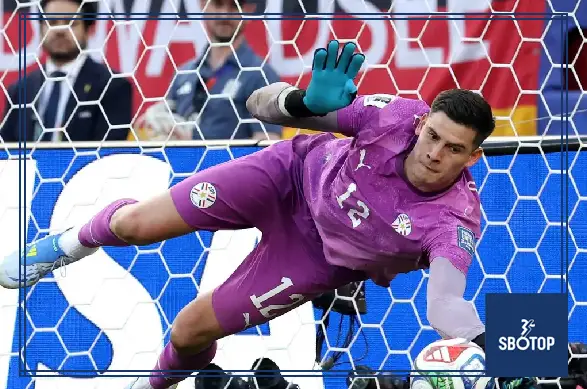
His most memorable performance came against Germany.
After making important saves during the match, Gill stopped two penalties in the shootout and helped Paraguay secure a historic victory. San Lorenzo celebrated the achievement, describing how their goalkeeper had denied two German penalty takers after performing strongly across the 120 minutes.
That display transformed his reputation.
Penalty shootouts create a unique stage for goalkeepers. Every save becomes a major moment, while confidence and psychological strength can be as important as technique.
Gill appeared calm under enormous pressure.
His height, reach and ability to read penalty takers made him a commanding presence. The performance was watched around the world and immediately encouraged speculation about a move to Europe.
A Goalkeeper With an Unusual Career Path
Gill’s rise has not followed the typical route of a highly rated international goalkeeper.
He was born in San Lorenzo, Paraguay, and developed in his home country before moving to San Lorenzo de Almagro in Argentina. He initially joined the Argentine club on loan and spent time with the reserve side before earning a permanent opportunity.
His breakthrough came after circumstances opened a pathway into the first team.
Once given the opportunity, Gill established himself through a combination of shot-stopping, physical presence and consistency. He later earned recognition with Paraguay and became part of the senior national-team setup.
The Paraguayan Football Association currently lists him among its senior goalkeepers, while San Lorenzo continue to name him as a member of their professional squad.
His career contains a strong element of perseverance.
Gill was not transferred between major European academies as a teenager, and he did not arrive at the World Cup with a large international reputation. He worked his way through less glamorous stages before receiving the opportunity to perform on football’s biggest platform.
That background makes his emergence particularly compelling.
Gill’s Physical and Technical Profile
Gill possesses several qualities that naturally attract scouting departments.
At approximately 1.99 metres tall, he has the size expected of a modern goalkeeper. His reach helps him cover a large area of the goal and gives him an advantage when dealing with crosses or penalties.
Height alone, however, does not create a top-level goalkeeper.
Gill also demonstrates quick reactions and the ability to set his body before shots arrive. His World Cup performances showed that he can make saves in crowded situations and remain composed when opponents create repeated pressure.
His penalty-saving record has become one of his most discussed strengths.
Successful penalty goalkeeping involves research, anticipation and emotional control. A goalkeeper must study the taker’s approach without moving too early. Gill showed those qualities against Germany.
There are still areas European clubs would need to examine carefully.
The Premier League places enormous demands on distribution. Goalkeepers are expected to receive passes under pressure, break pressing structures and make accurate decisions with both short and long deliveries.
Gill’s ability with the ball would therefore receive as much attention as his shot-stopping.
Clubs would also assess how consistently he commands the penalty area. A goalkeeper of his height should dominate crosses, but timing, communication and decision-making remain essential.
Manchester United Already Have a Crowded Department
Romano’s explanation is supported by the size of United’s goalkeeping group.
Manchester United’s official first-team page lists Lammens and Bayindir as senior goalkeepers, with Onana identified as being away on loan. Tom Heaton has also remained around the senior structure, providing experience and depth.
That means United do not lack numbers.
The question is whether they possess sufficient quality, and Lammens’ first campaign appears to have answered much of that concern.
Signing Gill would create an unnecessarily complicated hierarchy unless another goalkeeper departed permanently.
If United sold Onana, they would still have Lammens and Bayindir. If Bayindir left, the club might promote another option or recruit a less expensive reserve rather than sign an international goalkeeper expecting regular matches.
Squad management is not simply about collecting talented players.
A club must maintain clear roles. Too many goalkeepers competing for one position can become difficult because unlike outfield players, they cannot easily rotate across several roles during a match.
Only one goalkeeper starts.
The second choice may feature in cup competitions, while the third option can spend long periods without playing. Gill’s recent rise makes such a role unlikely to appeal to him.
Senne Lammens Is Central to United’s Planning
Lammens appears to be the decisive factor behind United’s lack of interest.
The Belgian arrived with potential but quickly demonstrated that he could perform in the Premier League. His regular appearances gave United stability and allowed the club to plan around a younger goalkeeper rather than searching for another expensive short-term solution.
At 24, Lammens also has room to improve.
Goalkeepers frequently reach their peak later than outfield players because experience, decision-making and positional understanding develop over time.
United can therefore reasonably believe that Lammens may become even stronger.
Recruiting Gill could disrupt that development.
Competition is healthy, but signing another goalkeeper at a similar stage of his career could create uncertainty over who the club truly trust. Unless United view Gill as a clear upgrade, such a move would provide limited benefit.
Romano’s comments imply that no such judgment has been made.
The club appear satisfied enough with their current options to direct money toward other priorities.
Other Areas Demand Greater Attention
Manchester United’s transfer plans extend far beyond goalkeeping.
The club continue to assess midfield and attacking reinforcements while managing the futures of several senior players. Spending even a relatively modest amount on Gill would reduce the resources available for positions with a greater immediate need.
A defensive midfielder, for example, may influence every phase of United’s play. The team need players who can protect the defence, control transitions and support possession.
Additional defensive depth could also become important during a long season.
Recruitment departments must prioritise.
A talented player can still be the wrong signing if the squad needs something else more urgently.
Gill may represent excellent value for another club. For United, he would currently be an unnecessary addition unless the goalkeeping situation changes significantly.
This appears to be the main message behind Romano’s clarification.
The Reported Release Clause Added Momentum
The suggestion that Gill could be available for a relatively low fee helped the rumour spread.
Reports claimed his contract contained a release clause of approximately $7 million. In modern Premier League terms, that figure would be affordable for Manchester United and could appear to offer significant value after his World Cup performances.
However, an affordable player is not automatically a necessary player.
Clubs sometimes complete deals because the price appears attractive, only to discover that the signing does not solve a meaningful squad problem.
United have previously been criticised for recruitment that lacked a coherent tactical strategy. Their current structure must avoid repeating that mistake.
Even if Gill were available for the reported amount, the club would still need to consider wages, agent fees, adaptation and playing time.
A transfer’s true cost extends beyond the initial fee.
The release-clause reports may also require verification. Contract details are often reported differently across markets, and the precise conditions may not be publicly available.
San Lorenzo Have Not Publicly Prepared for a United Transfer
There is no official indication from San Lorenzo that Gill is close to joining Manchester United.
The Argentine club welcomed him back to training after the World Cup and continue to celebrate his international achievements. Their official first-team information lists him as part of the squad.
That does not mean he will definitely remain.
Transfer windows can develop quickly, particularly after a player produces a breakthrough tournament. San Lorenzo may receive offers from Europe or other markets.
However, the public evidence does not support the idea that a United transfer is advanced.
No official bid has been announced. No agreement has been confirmed, and Romano has specifically rejected the claim that United are currently negotiating.
The responsible conclusion is therefore that the story remains unsupported.
Also Read: