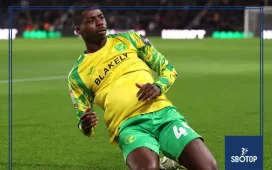



Jack McGlynn supplied the imagination and Stoke City survived the drama as the Potters defeated Blackburn Rovers 2-1 at Ewood Park on November 3. An inventive free-kick from the American midfielder broke the deadlock before a second-half own goal gave the visitors a cushion that proved essential during a tense finish.
Andri Gudjohnsen’s late reply revived Blackburn, and the striker subsequently thought he had rescued a point. His header was disallowed, however, leaving Stoke to celebrate a victory built on an exceptional opening goal, opportunism and the ability to withstand a difficult closing spell.
For Stoke, the evening demonstrated how individual quality can change an uncomfortable contest. For Blackburn, it was another reminder that promising periods of football offer little protection against decisive mistakes.
Blackburn Make the Early Running
Blackburn began with enough attacking intent to make the visitors work. Todd Cantwell tested Viktor Johansson early, while Hayden Carter also forced the Stoke goalkeeper into action after advancing onto a loose ball.
Those opportunities mattered beyond their immediate threat. They offered Blackburn encouragement that Stoke could be troubled by direct running and shots taken before the visiting defence had fully settled. Johansson’s interventions prevented that early pressure from becoming an advantage on the scoreboard.
The distinction between creating pressure and establishing control became important as the match developed. Blackburn had reasons to feel encouraged, but their progress remained vulnerable while the score stayed level.
From Stoke’s perspective, surviving that opening period preserved the opportunity to influence the game later. A goalkeeper’s contribution can easily become overshadowed when an attacking player produces the evening’s most memorable moment. Here, the early saves helped create the conditions for McGlynn’s intervention to carry maximum weight.
A Free-Kick That Changed the Evening
The breakthrough arrived in the 43rd minute from a position where Blackburn could reasonably have anticipated a delivery into the penalty area. Instead, McGlynn sent the ball towards goal from wide on the left.
Balazs Toth got a hand to the effort but could not prevent it crossing the line. The goal gave Stoke a lead shortly before half-time and rewarded a decision that combined awareness with difficult execution.
Its significance lay partly in the surprise. Defending a wide free-kick involves several competing responsibilities: monitoring runners, protecting dangerous spaces and judging the likely flight of the delivery. McGlynn exploited the possibility that the goalkeeper would prepare for a cross.
That does not make the finish straightforward. Recognising an opportunity and placing the ball accurately enough to exploit it are separate challenges. His contribution succeeded because the idea survived the technical demands.
A match that had offered Blackburn encouragement suddenly required them to recover from behind.
Why McGlynn’s Decision Mattered
McGlynn’s goal illustrated the value of a player willing to depart from the obvious option. Set pieces often follow familiar patterns, with attackers competing for a delivery and defenders organising around those expectations.
An unexpected attempt changes the problem immediately. The goalkeeper must reassess the ball’s destination while already positioned for another possibility. Even a brief delay can become decisive when the execution is accurate.
There is also a wider tactical benefit to such a goal. Future opponents may feel obliged to respect the direct attempt from similar positions, potentially affecting how aggressively they defend the anticipated cross.
That remains a possible consequence rather than an established outcome. One successful free-kick does not guarantee repeated success or prove that every opponent will adjust.
What the incident did establish was McGlynn’s influence on this match. His willingness to attempt something unusual supplied the advantage Stoke had not found through their earlier attacking play.
Stoke Find a Crucial Second Goal
The visitors added their second in the 68th minute through an unfortunate sequence for Blackburn. Million Manhoef’s effort was saved by Toth, but Yuri Ribeiro’s attempted clearance struck fellow substitute Moussa Baradji and rebounded into the net.
The official scoring record credited Baradji with an own goal. Both he and Ribeiro had entered the match shortly beforehand, making their involvement especially frustrating for a Blackburn side trying to change the contest.
The finish contained obvious misfortune, although Stoke’s attack created the emergency that preceded it. A saved shot does not necessarily end a dangerous passage. Defenders still have to judge the rebound, account for nearby players and find a safe direction for the clearance.
For Blackburn, that second phase unravelled. For Stoke, it provided breathing space and changed the demands of the remaining minutes.
At 1-0, a single lapse could erase their advantage. At 2-0, Blackburn needed a more substantial recovery.
Blackburn’s Possession Brings Limited Reward
Blackburn finished with 58 per cent possession and 14 attempts to Stoke’s 11. Those figures support the impression of a home side that remained involved, but they do not establish that every spell of possession carried equal danger.
The match statistics also recorded three shots on target for each team. Blackburn’s greater volume therefore did not produce a corresponding advantage in efforts that required a save or resulted in a goal.
This is where a narrow defeat becomes difficult to assess through one measure. Possession can reflect useful territorial pressure, patient construction or an opponent’s willingness to defend an existing lead. Its meaning depends on what happens next.
Blackburn had enough involvement to keep pursuing the match. Their difficulty was converting that involvement into a decisive return before the closing stages.
For Stoke, the figures reinforce that this was a victory earned without monopolising the ball. Their success depended on making particular moments count.
Gudjohnsen Gives Rovers Late Hope
Blackburn finally reduced the deficit in the 87th minute. Sam Morsy’s shot was not held by Johansson, and Gudjohnsen reacted to finish the rebound.
The striker then headed in again around the end of normal time, only for referee Andrew Kitchen to penalise him for a push on Ben Wilmot. That decision denied Blackburn an equaliser and became the central controversy of the finish.
Gudjohnsen’s contribution showed why penalty-area awareness remains valuable even when a team is struggling to find a breakthrough. A rebound rewards the forward who continues the action rather than assuming the goalkeeper will secure the initial effort.
His goal also changed the emotional conditions of the match. Stoke’s cushion disappeared, Blackburn’s urgency acquired a tangible reward, and every subsequent delivery carried greater significance.
The visitors were suddenly defending a narrow lead against opponents who could see a route back into the contest.
A Disputed Header and Different Interpretations
Blackburn manager Tony Mowbray strongly disagreed with the decision to disallow Gudjohnsen’s header. Stoke counterpart Mark Robins considered the ruling correct.
Their opposing assessments reflected the importance of the incident, but neither reaction changes the confirmed outcome: the referee awarded a foul, the header did not count, and Stoke retained their lead.
It is reasonable to discuss whether the contact warranted a foul without presenting either manager’s interpretation as an independently established fact.
The episode also creates a temptation to make the entire match about one whistle. That would overlook the earlier opportunities, McGlynn’s opening goal and the defensive confusion surrounding Stoke’s second.
Blackburn’s frustration was understandable because the disallowed header appeared to complete a dramatic recovery. Nevertheless, their need for that recovery had developed long before the disputed decision.
Stoke, meanwhile, could acknowledge their narrow escape while still valuing the work that placed them ahead.
Another Away Win Strengthens Stoke’s Position
The result extended Stoke’s sequence to four consecutive away victories and lifted them to third in the Championship at the conclusion of the evening’s action. McGlynn’s strike was his fourth goal of the campaign. x
Those achievements gave the result significance beyond a single successful trip. Winning repeatedly away from home requires answers to different challenges, including hostile environments, periods without possession and opponents prepared to take the initiative.
Stoke found an answer here through a mixture of individual skill and collective survival. That combination can be valuable across a demanding league schedule, although it should not disguise the vulnerability visible during the final minutes.
A strong run supports ambition; it does not guarantee promotion. Maintaining momentum requires performances that can survive changes in form, selection and opposition.
The immediate achievement was clear enough. Stoke left Ewood Park with another away victory and further evidence that they could win a competitive match under pressure.
Lessons Beyond the Scoreline
For Blackburn, the useful response lies in examining both the encouraging football and the decisive errors. Their early chances and late threat offered evidence of attacking capability. The goals conceded exposed how quickly that work could be undermined.
For Stoke, the lesson was similarly balanced. McGlynn provided a match-changing piece of invention, and the team created the pressure that led to the second goal. Yet the closing stages showed how rapidly apparent comfort can disappear.
Neither side needs an exaggerated interpretation of the evening. Blackburn were competitive enough to threaten a comeback but left without a point. Stoke produced the decisive moments but had to protect them until the finish.
McGlynn’s free-kick will remain the defining image: a player seeing an opening where most expected a cross, then possessing the precision to exploit it. Around that moment, Stoke assembled a valuable victory, while Blackburn were left considering how a match containing so much promise had escaped them.
Also Read: