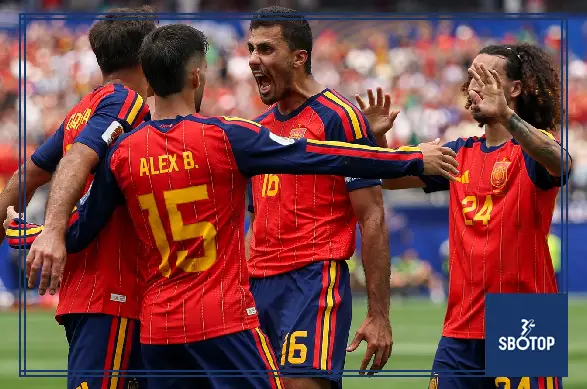
Spain arrived at the knockout stage carrying both expectation and a little uncertainty. As reigning European champions, Luis de la Fuente’s side were always going to be judged by a different standard. Winning was not enough; the question was whether Spain could look sharp, controlled, and ruthless when the pressure of elimination began. Against Austria, they answered with their most complete performance of the 2026 World Cup so far.
A 3-0 victory in Los Angeles sent Spain into the last 16, but the scoreline only tells part of the story. This was not a fortunate win or a narrow escape disguised as dominance. Spain controlled the rhythm, suffocated Austria’s attacking routes, created chances from both flanks, and finished the contest with the confidence of a side growing into the tournament at exactly the right time. Mikel Oyarzabal scored twice, Pedro Porro added the second, and Austria were left chasing shadows for most of the afternoon. Spain’s win also continued their remarkable defensive streak, with De la Fuente’s team yet to concede a goal in the tournament.
The group stage had raised some doubts. Spain had begun with a goalless draw against Cape Verde, then gradually found rhythm through wins over Saudi Arabia and Uruguay. But this was different. This was the first time in the competition that Spain truly looked like the European champions who could impose themselves on a knockout match and make an opponent feel trapped.
Oyarzabal Takes the Centre Stage
Mikel Oyarzabal was the face of Spain’s victory. He opened the scoring late in the first half and added the third near the end, taking his tally to four goals at the World Cup. In a squad full of glamorous names, creative midfielders, and the headline-grabbing teenage brilliance of Lamine Yamal, Oyarzabal once again proved why he is so valuable to Spain. He may not always dominate highlight reels with flashy dribbles, but his timing, movement, and finishing make him a perfect fit for this system.
His first goal arrived after Spain had turned sustained pressure into inevitability. Marc Cucurella delivered a precise cross from the left, and Oyarzabal guided the ball into the bottom corner with the calmness of a striker who understands space before it appears. The finish was not spectacular, but it was exact. It rewarded Spain’s patience and forced Austria to abandon the defensive comfort that had kept them alive until that point.
His second, in the 89th minute, underlined the same quality. Austria’s defensive structure had finally frayed, and Spain punished the lapse with another smooth attack. Cucurella was again involved, and Oyarzabal arrived at the right time to finish the move and close the contest. Sky Sports described the win as a comfortable passage into the round of 16, with Oyarzabal and Porro supplying the goals that ended Austria’s campaign.
This was the kind of performance that strengthens a player’s role in a tournament. Oyarzabal did not simply score; he gave Spain a reliable reference point in attack.
Austria’s Early Resistance Was Real
Austria did not arrive as an easy opponent. Ralf Rangnick’s side had fought their way into the knockout stage and had already shown they could survive chaos. Their draw with Algeria had required late drama, and they entered the match with enough energy and organisation to believe they could frustrate Spain.
For a while, they did. Spain started brightly, but Austria competed with courage. Konrad Laimer pushed forward when possible, Marcel Sabitzer looked for dangerous deliveries, and Michael Gregoritsch almost benefited from one inviting cross. Austria were not passive. They pressed when they could, tried to disrupt Spain’s first line of possession, and looked to make the game uncomfortable.
But the problem with facing Spain is that resistance must be perfect for 90 minutes. One missed rotation, one late defensive shift, one cross that is allowed to travel, and the entire plan can collapse. Austria stayed in the contest for much of the first half, helped by goalkeeper Alexander Schlager, who made important saves before the interval. Yet once Oyarzabal gave Spain the lead, Austria’s route back became increasingly narrow.
Rangnick later acknowledged the level of the opponent, admitting that Austria remained alive until the second goal but struggled to survive the full match against a team of Spain’s quality.
Spain’s Full-Backs Changed the Match
One of the most striking elements of Spain’s performance was the influence of their full-backs. Marc Cucurella and Pedro Porro gave Spain width, aggression, and constant forward thrust. They did not simply support attacks; they helped define them.
Cucurella was central to the opening goal and the third, repeatedly finding space on the left and delivering with purpose. Porro, meanwhile, provided the second goal with a close-range header after another flowing Spain move. The Guardian noted that Spain’s full-backs were flying, with their energy helping the team stretch Austria and turn possession into pressure.
Porro’s goal in the 66th minute effectively ended the contest. Until then, Austria still had a faint hope. They had brought on Sasa Kalajdzic, the stoppage-time hero from the Algeria match, and he nearly produced another important moment with a header that landed on top of the goal. But Spain soon punished them at the other end. A long move was recycled, the ball was worked back into the box, and Porro powered in to make it 2-0.
That goal reflected Spain’s modern identity. They are still a team built on passing, control, and positional play, but this version has more directness from wide areas. They can hurt opponents through midfield combinations, winger isolation, full-back runs, and well-timed crosses. Austria discovered that stopping one route did not stop the machine.
Lamine Yamal’s Rhythm Is Returning
Lamine Yamal did not score, but his performance mattered. The 18-year-old repeatedly troubled Austria’s defensive shape, especially early in the match. His first-minute effort set the tone, and his duel with Laimer became one of the key battles of the afternoon. Spain’s attack often seems to breathe differently when Lamine receives the ball. Defenders backpedal, midfielders shift across, and space opens elsewhere.
Reuters reported that Lamine looked increasingly free from the hamstring issue that had affected him earlier in the tournament. After the match, he said he was gradually feeling like himself again, referencing the runs and dribbles that make him so dangerous.
That is excellent news for Spain. Oyarzabal may have taken the headlines against Austria, but Lamine remains the player who changes the emotional temperature of a match. He draws attention, creates panic, and gives Spain a one-on-one threat that previous generations sometimes lacked.
Against deeper, more disciplined opponents, his ability to beat a marker could become decisive. Against Portugal in the next round, his duel with Nuno Mendes is already shaping up as one of the biggest tactical battles of the last 16. Reuters has highlighted that matchup, noting Mendes is likely to be tasked with containing Lamine while still offering Portugal a counterattacking outlet.
Spain’s Defence Is Becoming a Championship Foundation
Spain’s attack will always attract attention, but their defence has quietly become one of the strongest stories of the tournament. Against Austria, they did not allow a single shot on target. Reuters reported that Spain became the first team since Germany in the 2014 World Cup final to achieve that feat in a knockout match.
That statistic says more than any possession figure. Austria had moments of promise and a few half-chances, but they never truly tested Unai Simón. Spain’s centre-backs controlled space, the midfield shielded transitions, and the full-backs recovered quickly after attacking. This was not just pretty football. It was control with defensive teeth.
The Guardian also noted that Spain kept a fourth consecutive clean sheet, with Unai Simón surpassing Iker Casillas’s 2010 title-winning shutout sequence. Pau Cubarsí and Aymeric Laporte were again praised as a centre-back partnership that has given Spain real balance.
That is why Spain look so dangerous. They are not merely outscoring teams. They are removing opponents from the game. When a team can dominate possession and prevent meaningful shots, the match becomes psychologically exhausting for the opposition.
Austria felt that exhaustion. Every time they tried to grow, Spain recovered the ball. Every time they tried to breathe, Spain pushed them back.
The Disallowed Goal Did Not Shake Spain
Before Oyarzabal’s opener, Spain thought they had scored through Cucurella after a scramble from a set-piece. The referee ruled it out for a foul on Schlager, a decision that frustrated Spain and temporarily gave Austria hope. Sky Sports described the call as controversial, but it proved to be only a short delay rather than a turning point.
That reaction was important. Knockout matches can turn on emotional swings. A disallowed goal can produce anxiety, especially for a favourite that has not yet fully convinced in the tournament. Spain did not lose patience. They simply kept applying pressure. They continued moving the ball, stretching Austria, and waiting for the next opening.
This is a sign of maturity. Spain did not complain their way out of rhythm. They trusted their process. The first legitimate goal eventually came, and from there the match moved steadily in their direction.
De la Fuente’s team looked like a side that understands its own identity. That matters more than any single tactical pattern. In knockout football, belief in the game plan is everything.
Also Read: