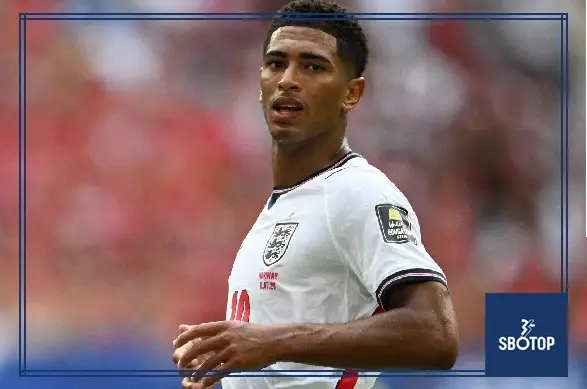
Jude Bellingham delivered one of the defining performances of England’s 2026 World Cup campaign against Norway, scoring twice to carry Thomas Tuchel’s side into the semi-finals. Yet amid the celebrations, television footage created an unwelcome source of anxiety.
Cameras appeared to show the Real Madrid midfielder grimacing and repeatedly touching his left shoulder after a forceful challenge during England’s dramatic 2-1 extra-time victory. Medical staff were reportedly watching from the technical area as Bellingham attempted to continue, immediately reviving memories of the recurring shoulder problem that required surgery in July 2025.
The images naturally concerned England supporters, particularly with a World Cup semi-final against Argentina approaching. Bellingham is not simply another member of Tuchel’s squad. He has become one of England’s most decisive performers, and his two goals against Norway once again demonstrated his ability to shape major tournament matches.
However, footage of a player experiencing discomfort does not by itself confirm a new dislocation, structural damage or failure of the previous operation. Bellingham completed the contest, scored the winning goal in extra time and participated in the post-match celebrations. No immediate medical diagnosis was included in the initial reports about the incident.
The situation therefore requires balance. England have every reason to assess their midfielder carefully, but there is not yet enough publicly available evidence to conclude that he has suffered a serious recurrence.
Cameras Capture a Familiar and Concerning Moment
The incident occurred during a physically demanding quarter-final in Miami. Bellingham was involved in a robust challenge and subsequently appeared to hold his left shoulder while showing visible discomfort.
For supporters familiar with his medical history, the reaction was instantly recognisable. Bellingham had previously spent an extended period playing with protection around the same shoulder after initially suffering a dislocation during his first season at Real Madrid.
The concern was increased by his body language. Rather than touching the area only once before immediately forgetting about it, he was shown apparently testing or managing the shoulder while continuing to play. Reports noted that England’s medical staff monitored the situation from the side of the pitch.
Yet Bellingham’s response also offered some encouragement. He did not leave the field, receive prolonged treatment or appear to ask for a substitution. He remained central to England’s performance and later scored the decisive goal.
That does not eliminate the possibility of pain. Footballers regularly continue through discomfort during major matches, especially when the stakes are as high as a World Cup quarter-final. It does, however, suggest that the problem did not immediately prevent Bellingham from running, competing or performing decisive actions.
The Shoulder Problem Dates Back to 2023
Bellingham’s difficulties with his left shoulder began during his first season at Real Madrid. The midfielder suffered a dislocation in November 2023 and subsequently returned to action while using heavy strapping to protect the joint.
For an extended period, the issue was managed rather than immediately corrected through surgery. That allowed Bellingham to continue playing for Madrid and England, but it also meant he had to adapt physically and mentally to the possibility of further discomfort.
The midfielder eventually underwent an operation on July 16, 2025. Real Madrid’s official medical report stated that the procedure was performed to address a recurrent dislocation of his left shoulder. He then began a rehabilitation programme before returning to training and competitive action.
The wording of the club’s announcement is important. The operation addressed instability caused by repeated dislocations. It was designed to correct the long-standing problem and reduce the likelihood of recurrence.
That does not mean a surgically repaired shoulder can never become painful again. Contact, awkward falls, muscle fatigue and direct blows can still produce soreness or temporary irritation. Without a clinical assessment, it is impossible to determine whether Bellingham’s reaction against Norway represented structural trouble, a brief impact or simple caution following his previous experience.
Surgery Was a Major Step in Bellingham’s Career
Bellingham later described the operation and rehabilitation as a particularly difficult experience. The decision followed a lengthy period in which he had competed while managing the injury, postponing surgery until the timing was considered appropriate for his club and international commitments.
That context explains why the Norway footage attracted so much attention. The operation was not performed to address a minor inconvenience. It followed a problem that had affected him for around a year and a half.
Rehabilitation from shoulder stabilisation surgery also involves more than waiting for pain to disappear. A player must rebuild strength, mobility, confidence and tolerance for contact. For a midfielder such as Bellingham, the shoulder is repeatedly tested when shielding the ball, contesting aerial challenges, falling under pressure and using the upper body during physical duels.
The psychological element is equally important. A player who has experienced recurrent dislocations may become highly aware of the joint whenever it receives a strong impact. Touching or testing the shoulder after a collision can therefore be a protective reaction rather than proof that it has dislocated again.
Bellingham’s willingness to remain on the field in Miami could indicate that he quickly became satisfied that the joint was stable. Only the England medical staff and the player himself can provide a reliable assessment.
His Performance Offered the Strongest Reassurance
Whatever discomfort Bellingham experienced, it did not prevent him from deciding the quarter-final.
Norway took the lead through Andreas Schjelderup in the first half, placing England under considerable pressure. Bellingham responded with an equaliser shortly before the interval and then scored again in extra time to complete the 2-1 comeback.
The result sent England into the fourth World Cup semi-final in their history. It also took Bellingham to six goals at the tournament, level with England captain Harry Kane at that stage of the competition.
His winning goal required awareness, movement and a rapid reaction after goalkeeper Ørjan Nyland failed to hold Morgan Rogers’ effort. Bellingham remained alert inside the penalty area and converted the rebound.
That sequence matters when considering his physical condition. A player dealing with an acute, serious shoulder injury might still be capable of running, but continuing to engage in challenges and attacking actions for the remainder of a 120-minute match would represent a substantial test.
Bellingham passed that test on the field. He was not merely present; he remained England’s most influential player.
The concern is therefore not that he was visibly incapable of continuing against Norway. It is whether the shoulder could react negatively after the match, once adrenaline decreased and inflammation had time to develop.
England Cannot Afford to Lose Him Before Argentina
Bellingham’s fitness carries enormous significance because England are preparing to face defending champions Argentina in Atlanta on July 15.
Tuchel’s team have become heavily dependent on Bellingham and Kane for goals. The England manager acknowledged after the Norway match that the pair had scored 12 of the team’s first 13 goals at the tournament, while also expressing a desire for more attacking contributions from elsewhere in the squad.
Bellingham’s role extends beyond finishing chances. He provides physical power through midfield, carries the ball through pressure and gives England an additional presence around Kane in the penalty area.
Against Argentina, his defensive work could be equally important. England will need midfielders capable of covering ground, competing physically and closing the spaces in which Lionel Messi and Argentina’s creative players operate.
A fully fit Bellingham offers those qualities. Even a slightly restricted version of the midfielder would alter Tuchel’s tactical calculations.
The England staff must therefore consider not only whether he can start but whether he can complete another high-intensity match that could again require extra time.
The Medical Team Will Look Beyond Whether He Feels Pain
Elite sports medicine does not judge availability through pain alone. A player may report discomfort but remain functionally capable, while another may feel relatively comfortable despite signs of instability that require caution.
England’s medical staff are likely to assess Bellingham’s movement, strength, range of motion and response to contact. They may also examine whether there was swelling, weakness, unusual positioning or a sense that the joint temporarily shifted during the challenge.
His reaction during training will be another important indicator. Passing drills may not stress the shoulder heavily, but competitive exercises, changes of direction and controlled contact can reveal whether he feels able to use his body naturally.
The staff will also need to separate ordinary post-match soreness from symptoms connected to the old instability.
There is no reason to assume that surgery has failed simply because Bellingham touched the shoulder after a collision. Operations reduce risk and correct underlying problems, but they do not make a joint immune to every future impact.
The responsible conclusion is that the incident deserves assessment, not that a serious injury has already been established.
Bellingham’s Playing Style Places Major Demands on the Joint
Bellingham is not a midfielder who avoids contact. His game depends on physical commitment.
He protects possession with his body, drives between opponents and frequently enters crowded penalty areas. Defensively, he challenges for loose balls and competes aggressively in midfield. Those actions make him effective, but they also expose his shoulders to repeated force.
The Norway match illustrated those demands. England struggled technically and were forced into a contest requiring determination rather than complete control. Tuchel later praised the team’s resilience while criticising the quality of its football.
Bellingham embodied that resilience. He continued demanding possession, attacking the box and engaging opponents despite the visible moment of discomfort.
Tuchel could ask him to modify certain actions against Argentina, but such instructions would be difficult to implement. Playing cautiously would reduce many of the qualities that make him valuable.
The greater priority is determining whether the shoulder is stable enough for him to perform naturally. A player preoccupied with protecting one side of his body may hesitate during tackles or avoid using his arm when holding off an opponent.
At the highest level, even minor hesitation can affect performance.
Managing Risk During a Major Tournament
The timing makes the situation especially complicated. There is little recovery time between the quarter-final and semi-final, and England are only one victory away from reaching the World Cup final.
In a league season, a club might rest a player for one or two matches as a precaution. Tournament football provides no such luxury. Missing the semi-final could mean missing the defining match of an international career.
Players often accept a greater level of discomfort in these circumstances, but medical decisions cannot be based solely on emotion. Allowing Bellingham to play through a genuinely unstable shoulder could expose him to another incident and potentially create a longer absence.
On the other hand, withholding him because of temporary soreness would significantly weaken England for a match against one of the strongest teams in the competition.
Tuchel and his staff must weigh immediate sporting importance against the player’s welfare. That balance becomes easier only when the medical findings are clear.
Bellingham’s previous operation gives doctors valuable information about the structure of the joint, the nature of the repair and the risks associated with different symptoms. Any decision should come from that evidence rather than speculation based on television footage.
England Have Alternatives, but No Direct Replacement
Should Bellingham be unable to start, Tuchel has other talented midfield and attacking options. Eberechi Eze, Morgan Rogers and other creative players can operate between the lines, while Declan Rice and Elliot Anderson can provide central control.
None offers precisely the same combination as Bellingham.
Eze can dribble and create in tight areas but does not provide identical defensive coverage. Rogers offers power and direct running but has less experience controlling matches at international level. Rice can advance from midfield but is most valuable when protecting England’s structure.
Bellingham combines elements of all three roles. He can function as a midfielder, a pressing presence and a second goalscorer behind Kane.
His tournament record has also strengthened his status as England’s player for decisive moments. Scoring twice in a difficult quarter-final reinforced the belief that he can produce something even when the team is not playing well.
That quality cannot be easily replaced through a formation change.
Also Read: