Argentina’s World Cup title defence survived another night of tension, controversy and physical exhaustion because Julián Álvarez produced a finish that belonged on the tournament’s biggest stage. For 111 minutes, Switzerland had frustrated the reigning champions with disciplined defending, brave counterattacks and extraordinary resistance after being reduced to ten players. A penalty shootout appeared increasingly likely, and Argentina’s control of possession had begun to feel less important with every passing minute.
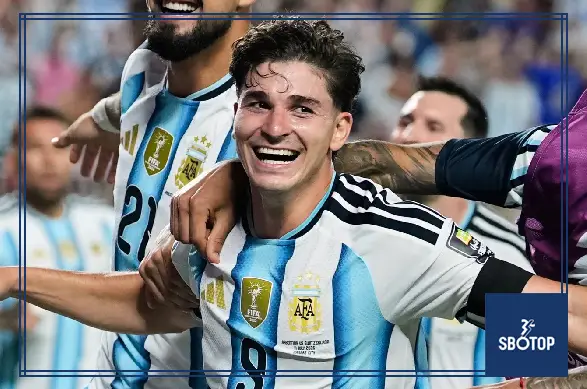
Then Álvarez created certainty from chaos. Receiving the ball outside the penalty area in the 112th minute, he set himself quickly and drove a magnificent shot beyond Gregor Kobel into the top corner. The goalkeeper stretched at full length but could not reach it. Lautaro Martínez added a third goal during the closing moments, completing a 3-1 extra-time victory that sent Argentina into a World Cup semi-final against England. The final margin suggested comfort; the match itself offered almost none.
Argentina Strike Early
Lionel Scaloni’s side began with the authority expected of defending champions. Argentina moved the ball sharply, pressed Switzerland’s first passes and attempted to establish control before their opponents could settle. Their reward arrived after ten minutes.
Lionel Messi delivered a precise corner toward the near-post area, where Alexis Mac Allister escaped his marker and redirected the ball with a clever header. The touch changed the angle just enough to defeat Kobel and carry into the far side of the net. It was an intelligent finish rather than a powerful one, perfectly suited to a move built on timing and awareness.
The early goal seemed to place Argentina in an ideal position. They could control possession, invite Switzerland forward and then attack the spaces left behind. Messi began drifting between the lines, Álvarez made energetic runs across the defence, and Argentina’s midfield attempted to keep the game at a manageable speed.
Ndoye’s Equaliser Rewards Swiss Pressure
Switzerland’s persistence produced its reward in the 67th minute. Ndoye exchanged passes with Rodríguez, entered the penalty area and directed a composed finish through Martínez’s legs. The move combined speed, precision and intelligent movement, exposing the defensive uncertainty that had entered Argentina’s performance.
The equaliser was deserved. Switzerland had attacked with growing purpose after halftime and had found a route around Argentina’s defensive shape. Their ability to create danger from wide positions will also interest England, whose energetic runners may target similar spaces in the semi-final. Argentina’s structure can become vulnerable when their midfield is forced to turn and chase toward its own goal.
For Argentina, the goal created a familiar test. Their knockout campaign had repeatedly demanded emotional resilience, and Switzerland had now removed the advantage that should have allowed Scaloni’s side to dictate the evening. The next few minutes would determine whether Argentina could restore control or allow the contest to become increasingly unpredictable.
A Controversial Red Card Transforms the Contest
Only five minutes after the equaliser, the quarter-final was changed by one of the tournament’s most debated refereeing decisions. Breel Embolo went down during a challenge involving Leandro Paredes. The referee initially cautioned Paredes, but a VAR review examined the incident under the competition’s expanded mistaken-identity interpretation.
Officials concluded that Embolo had simulated contact. The caution was reassigned to the Swiss forward, who had already been booked. His second yellow card became a red, leaving Switzerland with ten players in the 72nd minute. Embolo departed in tears while Swiss players and staff protested furiously.
The decision immediately became larger than the incident itself. Switzerland coach Murat Yakin criticised the ruling, while debate continued over whether VAR had intervened too aggressively. The controversy will remain inseparable from the match because Switzerland had equalised only moments earlier and appeared capable of creating further problems.
Argentina benefited from the numerical advantage, but the dismissal did not make victory automatic. Switzerland reorganised quickly, abandoned unnecessary risks and concentrated on protecting the central areas around Kobel.
Argentina Take Control but Lose Clarity
With Switzerland reduced to ten men, Argentina pushed almost every available player forward. The full-backs advanced, the midfield compressed the pitch and Messi searched for spaces around the penalty area. Scaloni introduced fresh attacking options, hoping new movement would pull the Swiss block apart.
The pressure became relentless, yet clear chances remained limited. Switzerland defended with courage and discipline, closing passing lanes and attacking every loose ball. Their centre-backs dealt with crosses, the midfield protected the edge of the area and Kobel remained composed whenever shots reached him.
Messi nearly decided the match late in normal time with a powerful attempt that travelled narrowly wide. The chance underlined the danger he continued to carry, even on a night when Switzerland prevented him from controlling every phase. When the final whistle ended regulation at 1-1, the ten-man Swiss had achieved something remarkable: they had forced the champions into another thirty minutes.
Álvarez Chooses the Boldest Solution
The decisive moment came in the 112th minute. Álvarez received possession outside the box and recognised that Switzerland’s defenders had protected the passing routes into the area. Instead of searching for another combination, he trusted his technique.
His strike carried power, lift and accuracy. The ball rose beyond the defensive line and curved into the top corner, leaving Kobel without a realistic chance. It was a goal created by confidence as much as skill. After nearly two hours of football, Álvarez still possessed the clarity to identify the opportunity and the courage to attempt the most difficult solution.
The celebration revealed the release of emotion. Argentina’s players raced toward the scorer, while the supporters transformed the stadium into a wave of noise. Switzerland’s resistance had finally broken, not through a complicated passing sequence but through one extraordinary action.
Lautaro Martínez Removes the Final Doubt
Switzerland attempted to respond, but the physical cost of defending with ten men had become overwhelming. Spaces appeared as they pushed forward, and Argentina exploited them during the final moments.
Thiago Almada forced a save from Kobel, and Lautaro Martínez reacted quickest to the rebound. His finish completed the scoring and confirmed Argentina’s place in the semi-finals.
The third goal gave the result a misleadingly comfortable appearance. Switzerland had been only minutes away from penalties and had spent a long period resisting with ten players. Argentina deserved credit for continuing to attack, but the scoreline did not reflect the uncertainty that defined most of the evening.
Switzerland Leave with Pride and Anger
Switzerland’s players ended the night devastated, but their campaign deserved admiration. They had reached their first World Cup quarter-final since 1954 and pushed the defending champions to the limits of extra time. Even after Embolo’s dismissal, they remained organised, brave and mentally committed.
Their frustration centred on the red card. Yakin and his players believed the VAR process had unfairly altered the match during their strongest period. The incident will continue to divide opinion, particularly because the interpretation used to change the original yellow card was unfamiliar to many supporters.
Yet Switzerland’s performance should not be reduced to controversy. Ndoye’s equaliser was the result of quality football, their defensive structure frustrated one of the tournament’s strongest attacks, and their physical effort after going down to ten men was exceptional.
They departed without a semi-final place, but they also left evidence that disciplined collective football can challenge even the reigning world champions.
Scaloni’s Bench Keeps Argentina Moving
Scaloni’s substitutions helped Argentina sustain pressure when the starting attack began to lose rhythm. Fresh legs widened the pitch, increased the tempo around Switzerland’s penalty area and ensured the champions could continue pressing immediately after losing possession. The changes did not produce an instant breakthrough, but they prevented Switzerland from escaping for long periods and gradually deepened the physical strain on the ten-man defence.
That depth could become decisive against England. An expanded World Cup places unusual demands on every squad, particularly when knockout matches repeatedly extend into extra time. Argentina can introduce Lautaro Martínez, Thiago Almada and other technically gifted players without abandoning their attacking identity. Their substitutes offer different movements rather than simple replacements, allowing Scaloni to adjust the structure while keeping Messi involved. Against Switzerland, the bench helped create the sustained pressure from which Álvarez’s winner and Lautaro’s final goal eventually emerged under the heaviest tournament pressure.
England Await in a Historic Semi-Final
Argentina’s reward is a semi-final against England, a fixture carrying enormous football and cultural history. The countries have produced unforgettable World Cup meetings, including Argentina’s controversial 1986 victory inspired by Diego Maradona and England’s emotionally charged win in 2002. Their latest encounter will be the first competitive meeting between them in 24 years.
England arrive after defeating Norway 2-1 in extra time. Jude Bellingham has become their decisive knockout performer, while Harry Kane remains the central reference in attack. Thomas Tuchel’s team have not always played fluent football, but they have demonstrated resilience similar to Argentina’s.
The semi-final therefore brings together two teams hardened by difficult routes. Both have survived extra-time battles, both possess match-winners and both understand that tournament progress often depends on enduring periods of discomfort.
Messi Meets England at Last
The occasion also carries personal significance for Messi. Despite his long international career, the semi-final is set to become his first senior match against England. At 39, he remains central to Argentina’s attempt to retain the trophy, even when opponents succeed in restricting his scoring opportunities.
Switzerland limited his influence in open play, but his corner created the first goal. That contribution demonstrates the problem England face: containing Messi does not mean eliminating him. One set piece, disguised pass or sudden change of direction can still reshape the contest.
England must decide how aggressively to track him. Giving him space invites creativity; following him too closely can create gaps for Álvarez, Lautaro and Argentina’s midfield runners. The tactical battle around Messi may determine where the semi-final is played and which team controls its rhythm.
England Can Exploit Argentina’s Weaknesses
The Switzerland match exposed areas England will attempt to target. Argentina’s defensive right side can be vulnerable against pace, and their midfield may struggle when opponents attack with sustained energy. Bellingham’s forward runs, England’s wide players and Declan Rice’s physical presence could create serious problems.
Set pieces may also become important. England possess greater height across several positions, while Argentina can look less comfortable when forced into repeated aerial duels. Tuchel will want his team to press with discipline, attack the flanks and avoid allowing Argentina to establish slow, controlled possession.
Argentina, however, will see opportunities of their own. England have made technical errors during the knockout rounds and have occasionally depended heavily on Bellingham’s interventions. Messi can punish careless spacing, while Álvarez’s movement can test defenders who step forward too aggressively.
Also Read: