The first semi-final of the 2026 World Cup places two of Europe’s most talented teams under one of football’s brightest spotlights. France and Spain will meet at Dallas Stadium with a place in the final at stake, and the responsibility for controlling the contest has been given to Salvadoran referee Iván Barton. FIFA confirmed Barton as the central official for the match, supported by assistant referees David Morán of El Salvador and Antonio Pupiro of Nicaragua. Sweden’s Glenn Nyberg will serve as fourth official, with Mahbod Beigi acting as reserve assistant referee.
Barton’s appointment is significant because this will be his fourth match at the tournament and the largest assignment of his 2026 World Cup campaign. He arrives having shown 11 yellow cards and one red across three previous games, an average of 3.67 cautions per appearance. Those numbers suggest an official willing to intervene when necessary without automatically turning every physical contest into a procession of bookings.
Tactical fouls, late challenges and emotional confrontations are all possible when the pressure rises. Barton’s decisions may therefore influence not only discipline, but also the rhythm in which the match is played.
Below are four key facts about the man selected to oversee one of the tournament’s defining fixtures.
Barton Is a Scientist and Teacher as Well as an Elite Referee
Iván Arcides Barton Cisneros was born in Santa Ana, El Salvador, on January 27, 1991. Long before his appointment to a World Cup semi-final, he built an unusual professional identity combining football officiating with academic achievement. Barton studied chemical sciences at the University of El Salvador and has worked as a university lecturer in organic chemistry. He has also described himself professionally as a FIFA international referee and a graduate in chemistry.
Barton joined FIFA’s international list in 2018. Within a relatively short period, he progressed through youth tournaments, Gold Cups, Nations League matches and major club competitions before reaching the senior World Cup. That progression suggests FIFA has viewed him as an official capable of handling increasing levels of speed, scrutiny and tactical complexity.
This Is Barton’s Second World Cup and His Biggest Assignment Yet
The France-Spain semi-final will not be Barton’s first experience on football’s largest stage. He officiated three matches at the 2022 World Cup in Qatar, including England’s Round-of-16 victory over Senegal. He showed only three yellow cards across those three games, demonstrating a comparatively restrained disciplinary approach during that tournament.
Returning for the 2026 edition confirmed that his Qatar performances had strengthened rather than damaged his standing within FIFA. This summer, he began with two group-stage appointments: Turkey against Paraguay and Japan against Sweden. He then took charge of Switzerland’s Round-of-16 meeting with Colombia, a tense elimination match that ended goalless before Switzerland advanced on penalties.
The progression of his assignments is important. FIFA generally assesses referees throughout a tournament, considering positioning, decision-making, communication, fitness and cooperation with video officials before awarding later-stage matches. A semi-final appointment indicates that Barton and his team have remained trusted deep into the competition.
It also places him in a very different environment from his previous matches. France and Spain feature global superstars, enormous television audiences and two federations accustomed to competing for trophies. Every major decision will be replayed from multiple camera angles, debated by analysts and circulated instantly online.
Barton’s experience at Qatar should help him manage that exposure. He has already officiated knockout football involving England, worked in front of vast crowds and dealt with players operating at the highest technical level. Yet a World Cup semi-final brings another degree of consequence. A penalty, red card or disputed goal could determine which nation reaches the final.
His wider résumé contains other high-pressure assignments. Barton refereed the first leg of the 2022 CONCACAF Champions League final between Pumas UNAM and Seattle Sounders, a match in which three penalties were awarded. He also controlled the heated 2023 CONCACAF Nations League semi-final between Mexico and the United States, issuing four red cards before the game ended early amid repeated crowd warnings over discriminatory chants.
Those experiences reveal an official familiar with conflict rather than protected from it. France against Spain may be more technically refined, but elite matches can become confrontational when fatigue and frustration grow. Barton has previously shown that he is prepared to take strong disciplinary action, even when doing so places him at the centre of the story.
His 11 Yellow Cards Do Not Tell the Whole Story
The number attached to Barton before the semi-final is 11. Across his three 2026 World Cup matches, he has issued 11 yellow cards, one red card and whistled 103 fouls. That works out at 3.67 cautions and roughly 34 fouls per match.
Those figures provide useful context, but they should not automatically define Barton as either strict or lenient. His card record has varied dramatically by competition. At the 2022 World Cup, he produced only three yellows in three games. In 21 Salvadoran league matches across 2025 and 2026, however, he showed 113 yellow cards and 12 reds.
The difference demonstrates how refereeing statistics depend on the matches being played. A domestic league with familiar rivalries, different tactical habits and more frequent confrontation may generate more disciplinary incidents than an international tournament. Game state also matters. An early goal can open a match, while a long period at 0-0 may produce repeated tactical fouls.
For France and Spain, the most relevant question is not whether Barton enjoys showing cards, but where he sets his threshold. Players will quickly study how much contact he allows, whether he punishes dissent and how he responds to attempts to stop transitions.
Spain may be particularly alert to fouls committed against Lamine Yamal and other dribblers. France’s defenders and midfielders must decide when to challenge and when to delay, knowing an early caution could limit aggression for the remainder of the match. France, meanwhile, will expect protection for Kylian Mbappé and Ousmane Dembélé when Spain attempt to halt counterattacks.
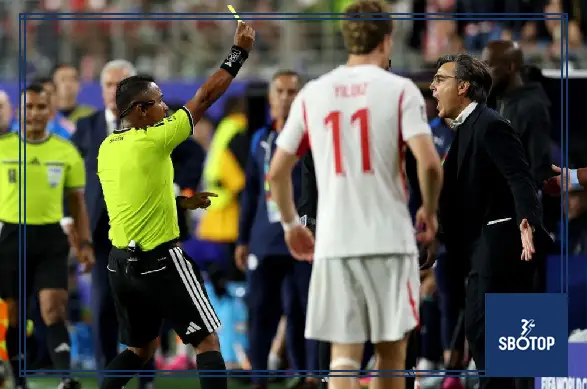
Barton’s management of the opening 20 minutes could shape everything that follows. An early card for a reckless challenge may establish a clear boundary and prevent escalation. Allowing too much contact could encourage increasingly physical play. Booking players too quickly, however, may leave him with limited options later.
The 11-yellow total also includes six cautions from Switzerland against Colombia, after he had shown only five across his first two tournament assignments. That shift suggests he responds to the character of the game rather than following a fixed quota. A World Cup semi-final must be managed on its own terms.
Another consideration is communication. Experienced referees often use verbal warnings, gestures and captain involvement before reaching for a card. Barton’s ability to explain decisions in Spanish may assist direct conversations with Spain’s players, while the international nature of France’s squad means English and standard refereeing signals will remain important.
A referee’s best performance is often one that becomes almost invisible. Barton will hope the semi-final is remembered for goals, tactical brilliance and individual quality rather than disciplinary controversy. Nevertheless, his 11 yellow cards remind both teams that he will act when his threshold is crossed.
He Made History With the Tournament’s Mouth-Covering Rule
Barton’s most discussed moment of the 2026 World Cup came during Turkey against Paraguay. Following a video review, he sent off Paraguay’s Miguel Almirón for covering his mouth while confronting an opponent. Barton became the first referee at the tournament to enforce the new disciplinary rule in that way.
The regulation was introduced to prevent players from hiding abusive, discriminatory or offensive language from cameras and match officials. Covering the mouth has long been common in football because players want to conceal tactical conversations. Under the new interpretation, however, using the gesture during a hostile confrontation can create serious disciplinary consequences.
Barton’s announcement of the decision attracted attention for its dramatic delivery, but the incident demonstrated something more important: his willingness to apply a new rule in a high-pressure match. Paraguay were forced to play the entire second half with ten men, although they still protected a 1-0 victory. Almirón later apologised to his teammates.
That episode may affect how France and Spain behave around him. Players know Barton has already enforced a regulation that many supporters and professionals were still learning. Heated exchanges, attempts to conceal comments and aggressive protests may therefore carry greater risk.
The incident also illustrates the expanded role of video review in the tournament. Barton had to receive information, examine the footage, interpret a new rule and communicate the outcome publicly. Modern officiating is no longer limited to what the referee sees in real time. It requires cooperation with a remote team while maintaining authority inside the stadium.
France and Spain must avoid allowing frustration to create unnecessary disciplinary problems. The match will feature intense individual battles, including those involving Yamal, Mbappé and the central midfielders. Players may disagree with decisions, but surrounding Barton or directing abuse toward opponents could invite sanctions.
This does not mean the semi-final is likely to produce a red card. It means Barton has already shown that reputation, occasion and match importance will not prevent him from making an unusual or unpopular decision when he believes the laws require it.
A Referee Positioned at the Centre of a Tactical Duel
France against Spain promises a contrast between explosive transition play and patient possession. Spain want to control the ball through Rodri, Pedri and their supporting midfielders before creating one-on-one opportunities for Yamal. France can defend compactly and then attack at extraordinary speed through Mbappé, Dembélé and Michael Olise.
That tactical contrast creates difficult refereeing situations. When France break forward, Spain may commit tactical fouls before the attack reaches the penalty area. When Spain circulate possession, France’s press may produce late contact as midfielders chase quick combinations. Barton must distinguish ordinary physical competition from deliberate attempts to destroy promising attacks.
Advantage decisions will be especially important. Stopping every foul immediately could interrupt the spectacle and protect the defending team. Allowing play to continue may create attacking opportunities, but only if Barton remains prepared to return and issue a caution afterward when required.
Penalty-area judgement will face similar scrutiny. Both teams possess attackers capable of changing direction rapidly and inviting contact. Barton must identify the difference between genuine fouls, unavoidable collisions and exaggerated reactions. VAR can correct clear errors, but the referee’s original positioning and interpretation remain central.
His assistants will also be crucial. Morán and Pupiro must monitor tight offside decisions against some of the fastest forwards in world football. Nyberg, as fourth official, will manage the technical areas, where Didier Deschamps and Luis de la Fuente are likely to react passionately to disputed calls. The crew’s success will depend on coordinated communication rather than Barton acting alone.
Also Read: